Part 4 of the Schema-Aware EF Core Migrations series. Read Part 1, Part 2, and Part 3 first.
We thought we had schema-aware migrations figured out. The SQL generator was rewriting table operations, the history table was per-schema, tests were passing. Then EF Core started complaining about "pending model changes"—even though there weren't any.
The Symptom
On application startup:
warn: Microsoft.EntityFrameworkCore.Model.Validation[10632]
      The model for context 'ApplicationDbContext' has pending changes.
      Add a new migration before updating the database.
The database was correct. Migrations had run. Tables were in the right schema. But EF Core kept insisting something was wrong.
Understanding the Root Cause
Here's what we missed: EF Core's schema handling happens in two completely different places.
1. SQL Generation (What We Had Solved)
Our SchemaAwareMigrationsSqlGenerator rewrites migration operations at SQL generation time:
// Input: CREATE TABLE [AspNetUsers] ...
// Output: CREATE TABLE [stg].[AspNetUsers] ...
This works beautifully. Tables get created in the correct schema.
2. Model Comparison (What We Hadn't Solved)
Before SQL generation even happens, EF Core compares the runtime model against the migration snapshot to detect pending changes. The comparison happens like this:
Snapshot Model (generated at migration time):
  HasDefaultSchema("local")
  Tables in "local" schema

Runtime Model (at application startup):
  HasDefaultSchema("stg")  <-- Different!
  Tables in "stg" schema

EF Core: "These models are different! You have pending changes!"
The schema is baked into the model. Even though our SQL generator would handle the difference at migration time, EF Core's model comparison sees a mismatch.
Why Suppressing Warnings Is Wrong
Our first instinct was to suppress the warning:
optionsBuilder.ConfigureWarnings(w =>
    w.Ignore(RelationalEventId.PendingModelChangesWarning));
This is dangerous. It masks legitimate warnings about actual pending changes. You'd never know if you forgot to create a migration for a new entity.
The Real Solution: IModelCacheKeyFactory
EF Core caches compiled models by context type. The default cache key is just typeof(ApplicationDbContext). That means every instance of your context—regardless of schema—shares the same cached model.
When the first context is created with schema "local", that model gets cached. When a second context is created with schema "stg", EF Core uses the cached "local" model and detects a mismatch.
The fix is to include the schema in the cache key:
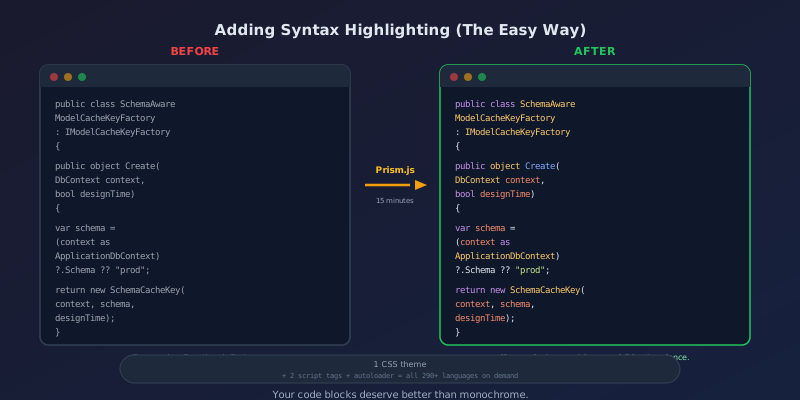
public class SchemaAwareModelCacheKeyFactory : IModelCacheKeyFactory
{
    public object Create(DbContext context, bool designTime)
    {
        // Read schema directly from ApplicationDbContext
        var schema = (context as ApplicationDbContext)?.Schema ?? "prod";
        return new SchemaCacheKey(context, schema, designTime);
    }
}

internal sealed class SchemaCacheKey : IEquatable<SchemaCacheKey>
{
    private readonly Type _contextType;
    private readonly string _schema;
    private readonly bool _designTime;

    public SchemaCacheKey(DbContext context, string schema, bool designTime)
    {
        _contextType = context.GetType();
        _schema = schema;
        _designTime = designTime;
    }

    public override bool Equals(object? obj)
    {
        return obj is SchemaCacheKey other && Equals(other);
    }

    public bool Equals(SchemaCacheKey? other)
    {
        return other is not null
            && _contextType == other._contextType
            && _schema == other._schema
            && _designTime == other._designTime;
    }

    public override int GetHashCode()
    {
        return HashCode.Combine(_contextType, _schema, _designTime);
    }
}
Now each schema gets its own cached model:
Cache key for "local" context: (ApplicationDbContext, "local", false)
Cache key for "stg" context:   (ApplicationDbContext, "stg", false)
No more false mismatch. No more suppressed warnings. The right solution.
Registration
Register the factory in both design-time and runtime:
// In DesignTimeDbContextFactory
optionsBuilder.ReplaceService<IModelCacheKeyFactory, SchemaAwareModelCacheKeyFactory>();

// In Program.cs
builder.Services.AddDbContext<ApplicationDbContext>(options =>
{
    options.UseSqlServer(connectionString, sql =>
        sql.MigrationsHistoryTable("__EFMigrationsHistory", dbSchema));

    options.UseSchemaAwareMigrations(dbSchema);
    options.ReplaceService<IModelCacheKeyFactory, SchemaAwareModelCacheKeyFactory>();
});
Reading Schema From DbContext
Notice the factory reads the schema from context.Schema:
var schema = (context as ApplicationDbContext)?.Schema ?? "prod";
This requires your ApplicationDbContext to expose the schema:
public class ApplicationDbContext : IdentityDbContext<ApplicationUser, IdentityRole<Guid>, Guid>
{
    private readonly string _schema;

    public ApplicationDbContext(
        DbContextOptions<ApplicationDbContext> options,
        IOptions<DatabaseSettings>? databaseSettings = null)
        : base(options)
    {
        _schema = databaseSettings?.Value?.Schema ?? "prod";
    }

    /// <summary>
    /// The configured database schema (for logging/debugging and cache key factory).
    /// </summary>
    public string Schema => _schema;
}
Why This Matters for Multi-Tenant Apps
If you're using EF Core with schema-per-tenant (or schema-per-environment like we are), the model cache key factory is essential. Without it, you'll either:
- Get false
PendingModelChangesWarningon every startup - Suppress the warning and miss real pending changes
- Overwrite cached models as different tenants/environments use the app
The cache key factory gives you proper isolation with no downsides.
The Complete Schema-Aware Stack
Across this series, here's the complete picture:
| Component | Purpose | Registration |
|---|---|---|
HasDefaultSchema() |
Runtime queries use target schema | OnModelCreating |
| Empty schema at design-time | Schema-less snapshot generation | DesignTimeDbContextFactory |
MigrationsHistoryTable() |
History table per schema | UseSqlServer() options |
UseSchemaAwareMigrations() |
Rewrite CREATE/ALTER/INDEX operations | DbContextOptionsBuilder |
ReplaceService<IModelCacheKeyFactory>() |
Runtime model caching per schema | DbContextOptionsBuilder |
MigrationHelper.Environment |
Environment-specific seed scripts | DesignTimeDbContextFactory |
Each solves a different problem. All six are required for robust schema-per-environment isolation. See the February 2026 update below for details on the schema-less snapshot requirement.
Testing the Cache Key Factory
Add tests to verify the cache key behavior:
[Fact]
public void SchemaAwareModelCacheKeyFactory_ImplementsInterface()
{
    var factory = new SchemaAwareModelCacheKeyFactory();
    Assert.IsAssignableFrom<IModelCacheKeyFactory>(factory);
}

[Fact]
public void SchemaAwareModelCacheKeyFactory_RegisteredViaReplaceService()
{
    var optionsBuilder = new DbContextOptionsBuilder<ApplicationDbContext>();
    optionsBuilder.ReplaceService<IModelCacheKeyFactory, SchemaAwareModelCacheKeyFactory>();
    // If no exception, registration pattern is valid
}
The Moral
EF Core's schema handling isn't a single problem—it's a constellation of related problems:
- SQL generation - Where tables get created
- Query generation - Where SELECT statements look for tables
- Model comparison - Whether EF Core thinks changes are pending
- Model caching - How EF Core stores compiled models
Our SchemaAwareMigrationsSqlGenerator solved #1. HasDefaultSchema() solved #2. But #3 and #4 required the model cache key factory.
Don't suppress warnings. Understand why they're firing and fix the root cause.
Schema-Aware EF Core Migrations series:
- Schema-Aware EF Core Migrations - The custom SQL generator approach
- The MigrationsHistoryTable Bug - Why history table schema matters
- Hardening Schema Migrations - Tests that let you sleep at night
- The Model Cache Key Factory - Preventing false PendingModelChangesWarning (this post)
- The Design-Time vs Runtime Mental Model - Why schema handling is actually two systems
With all six pieces in place (see the February 2026 update below), you have production-grade multi-tenant schema isolation in EF Core.
Update: The Missing Piece - Schema-Less Snapshots
February 2026
After deploying the cache key factory, CI started failing with PendingModelChangesWarning. Turns out we were solving the wrong problem.
What the Cache Key Factory Actually Solves
The cache key factory prevents runtime model cache collisions—when the same process creates contexts with different schemas, each gets its own cached model. This is important for:
- Multi-tenant apps serving different schemas simultaneously
- Tests that run with different schema configurations in the same process
What It Doesn't Solve
The cache key factory does NOT prevent PendingModelChangesWarning triggered by snapshot comparison. EF Core compares the runtime model against the snapshot file (ApplicationDbContextModelSnapshot.cs) before any caching happens.
If your snapshot has HasDefaultSchema("local") but you run with schema "dev", EF Core sees a mismatch—regardless of caching.
The Root Cause
Our DesignTimeDbContextFactory was passing the actual schema to DatabaseSettings:
// OLD (problematic)
var databaseSettings = Options.Create(new DatabaseSettings { Schema = schema });
This caused OnModelCreating to call HasDefaultSchema("local"), which got baked into the snapshot. When CI ran with "dev" schema, the models didn't match.
The Real Fix
Keep the snapshot schema-less by passing empty schema at design-time:
public class DesignTimeDbContextFactory : IDesignTimeDbContextFactory<ApplicationDbContext>
{
    public ApplicationDbContext CreateDbContext(string[] args)
    {
        var schema = environment switch { ... };  // Still compute for SQL generator

        optionsBuilder.UseSqlServer(connectionString, sql =>
            sql.MigrationsHistoryTable("__EFMigrationsHistory", schema));

        optionsBuilder.UseSchemaAwareMigrations(schema);  // SQL generator uses schema
        optionsBuilder.ReplaceService<IModelCacheKeyFactory, SchemaAwareModelCacheKeyFactory>();

        // CRITICAL: Pass empty schema to DatabaseSettings
        // This prevents HasDefaultSchema() from being called in OnModelCreating
        // The snapshot stays schema-less, compatible with all environments
        var databaseSettings = Options.Create(new DatabaseSettings { Schema = string.Empty });

        return new ApplicationDbContext(optionsBuilder.Options, databaseSettings);
    }
}
With this fix:
- Snapshot: No schema (tables use
ToTable("X", (string)null)) - SQL Generation: Schema applied via
SchemaAwareMigrationsSqlGenerator - Runtime Queries: Schema applied via
HasDefaultSchema()inProgram.cs - Runtime Caching: Schema-aware via
SchemaAwareModelCacheKeyFactory
Handling Tests
Tests need the actual schema for queries to work, so they'll still see a model/snapshot mismatch. But since migrations apply correctly (via the SQL generator), we can safely log the warning instead of throwing:
// In test fixtures only
options.ConfigureWarnings(w => w.Log(RelationalEventId.PendingModelChangesWarning));
This is different from Ignore() which suppresses completely. Log() still records the warning for visibility, but doesn't fail the migration.
The Complete Six-Component Stack
| Component | Purpose | Where |
|---|---|---|
HasDefaultSchema() |
Runtime queries | OnModelCreating (runtime only) |
| Empty schema at design-time | Schema-less snapshot | DesignTimeDbContextFactory |
MigrationsHistoryTable() |
History table per schema | UseSqlServer() options |
UseSchemaAwareMigrations() |
Rewrite DDL operations | DbContextOptionsBuilder |
ReplaceService<IModelCacheKeyFactory>() |
Runtime model caching | DbContextOptionsBuilder |
MigrationHelper.Environment |
Environment-specific seeds | DesignTimeDbContextFactory |
The cache key factory is still essential for runtime isolation. But preventing snapshot contamination is the key to avoiding PendingModelChangesWarning in CI.