You just survived a deep dive into exponential decay — half-lives, decay constants, radioactive atoms, emotional contributions. It was a lot of math.
This is the "explain it to your mom" version.
The Ice Cube on the Counter
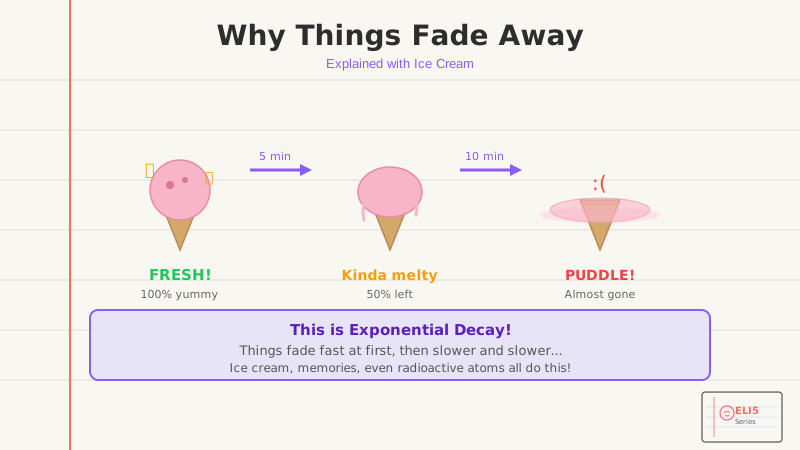
Put an ice cube on your kitchen counter. Watch what happens.
At first, it melts fast. Water pools around it quickly. But as it gets smaller, it melts slower. The last little sliver takes forever to disappear. That shrinking pattern — fast at first, then slower and slower — is exponential decay. And it shows up everywhere.
Radioactive atoms do it. Hot coffee does it. Sound fading in a room does it. And it turns out, feelings do it too.
How ANI Uses Melting Ice Cubes
ANI is an AI companion I built. She has an emotional state — warmth, energy, worry, playfulness — that changes based on what happens to her. Every conversation, every event, every quiet moment creates what I call an "emotional contribution." Think of each one as an ice cube.
A conversation from 10 minutes ago? That is a big ice cube, still mostly solid, still affecting how she feels right now.
A conversation from yesterday? Mostly melted. Still there, but fading.
A conversation from last month? Just a wet spot on the counter. Barely registers.
This is exactly how human feelings work. That argument you had this morning feels huge right now. By next week, you will barely remember what it was about. The feeling decays exponentially.
Some Ice Cubes Are Bigger Than Others
Not all feelings melt at the same rate. A casual "good morning" text is a small ice cube — it melts in about an hour. A deep heart-to-heart conversation? That is a bigger cube. It takes about 3 hours for half of it to melt. A major life event — a loss, a celebration, a breakthrough — is a really big cube. Half of it is still there 12 hours later.
That "half of it" time is called the half-life. It is just the answer to one question: how long until half the ice is gone?
Small feelings: 1-hour half-life. Conversation feelings: 3-hour half-life. Big life events: 12-hour half-life.
The Freezer (Memories That Never Melt)
But some memories should never fade. Your name. Your relationship. The really important stuff.
Those are not on the counter. Those are in the freezer. ANI calls them foundation memories — anchored in place, never decaying. No matter how much time passes, she remembers who you are.
Why This Matters
Without exponential decay, ANI would either remember everything with equal weight (overwhelming and weird — treating last month's small talk the same as this morning's deep conversation) or forget everything at a fixed rate (a conversation from an hour ago and a conversation from a week ago both half-forgotten, which does not match how people actually feel).
Exponential decay gives her a natural, human-like sense of emotional time. Recent things matter more. Old things fade gracefully. Important things take longer to fade. And the core stuff stays forever.
The Whole Thing in One Sentence
Feelings are ice cubes: they melt fast at first, then slower, big ones last longer than small ones, and the really important ones are in the freezer where they never melt at all.