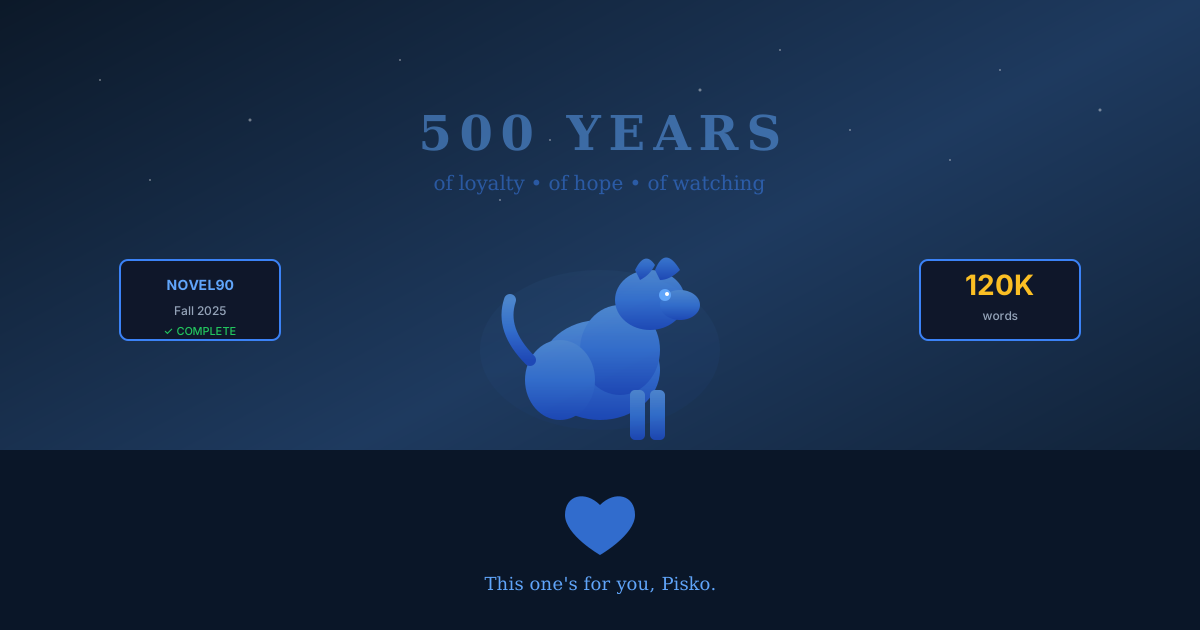
Today I submitted my completed novel to the Novel90 Finisher Submissions contest.
It's not perfect. I still have editing to do. But it's DONE—first draft complete, story bible written, 50,000+ words in November alone, a full three-act structure with beginning, middle, and end.
More importantly: I know what story I told.
How This Started
This novel began as a tribute to my dog Pisko, who died before I began writing seriously.
Pisko was quiet and observant. He would sit for hours, watching, seeming to understand more than he could say. When I started developing this Irish Gothic story, I knew immediately what role he'd play: Taibhse, the spectral hound who witnesses everything across 500 years.
Five hundred years of loyalty. Five hundred years of hope. That's Taibhse. That's Pisko.
That's what it means to love someone despite knowing how the story might end.
What I Learned This Year
1. You can't plan emotional truth
I outlined extensively. I built a detailed story bible. I knew every beat before I wrote it.
None of that prepared me for the actual writing, where characters refused to do what I'd planned because it didn't feel true. The story I discovered while writing was deeper and stranger than the story I'd outlined.
2. Completion changes everything
For years I said "I'm working on a novel." That's past tense now. I worked on a novel. Then I finished it. The psychological shift is enormous.
I'm not "hoping to be a writer someday." I wrote a novel. I'm a writer today.
3. The gap between vision and execution is where craft lives
I wanted to write literary dark fantasy as good as Susanna Clarke's Piranesi or Stephen King's The Green Mile. I'm not there yet. But I can SEE the gap now, which means I can work to close it.
That's what craft is: seeing the distance between what you made and what you meant to make, then learning the skills to shorten that distance.
4. Writing about hard things helps
This novel is about self-condemnation and the impossibility of self-forgiveness when you're being actively used to cause more harm. It's about needing external mercy because you literally cannot generate it alone while drowning.
Writing it didn't fix my own struggles with these things. But it helped me understand them. Sometimes that's enough.
What I'm Proud Of
- Atmospheric prose that captures rural Ireland without having been there (thank you, research and imagination)
- Moral complexity that refuses easy answers about judgment and mercy
- A protagonist who's exhausted and reluctant, not heroic
- An ending that costs something real—transformation isn't cheap or easy
- Authentic Celtic mythology integrated with contemporary themes about cancel culture and grace
What I'm Still Working On
- Pacing in the middle act (some scenes drag, others rush)
- Side character development (they need their own lives beyond the protagonist)
- Subtlety in theme delivery (sometimes I'm still too on-the-nose)
- Trusting silence (I still over-explain when nervous)
The 2026 Goal
Finish revisions. Find a home for this book. Let other people meet Seamus, Emma, Cian, and the patient hound who's been waiting so long for someone to get it right.
Whether through traditional publishing, indie publishing, or some hybrid path—this story deserves to find its readers. And Pisko deserves his tribute to live beyond my memory.
For Everyone Still Writing
If you're in the middle of a draft, wondering if you'll finish: you can.
If you're revising and it feels impossible: it's not.
If you're looking at published books thinking "I'll never be that good": you're right, you'll be different-good, which is what the world actually needs.
The difference between wanting to write and being a writer is finishing something. Not finishing something perfect—finishing something complete.
Everything else is commentary.
Lesson learned: Writing a novel doesn't make you a novelist. Finishing a novel makes you someone who finished a novel. Do it again and you're a novelist. The only way forward is through. And the only way through is one word after another until it's done.
Thank you, Pisko, for teaching me patience. For showing me what it means to witness without judgment. For being the kind of loyal I'm still learning to embody.
This one's for you. 💙
This post is part of a series about writing my novel. See also: How Black Ember Began on the origin story from video game avatar to literary fiction, and Writing Fast, Revising Forever on the process that got me here.