Let me save you some time: ChatGPT will not write your novel for you.
I know. The marketing suggests otherwise. "Generate entire stories!" "AI co-writer!" "Never stare at a blank page again!"
I believed it. I tried it. I have strong opinions now.
The Promise
The pitch is seductive: feed AI your plot outline, characters, and world-building, then let it generate prose while you supervise. Edit the output, refine it, and suddenly you're producing chapters at superhuman speed.
In theory, you become the director. AI becomes the writer. You just approve the words.
In practice? It's more like hiring a very enthusiastic intern who doesn't listen, doesn't remember, and thinks every scene needs more drama.
What I Actually Got
I gave ChatGPT a detailed character description. Sarah: mid-thirties, practical, works in logistics, speaks in short sentences, doesn't suffer fools.
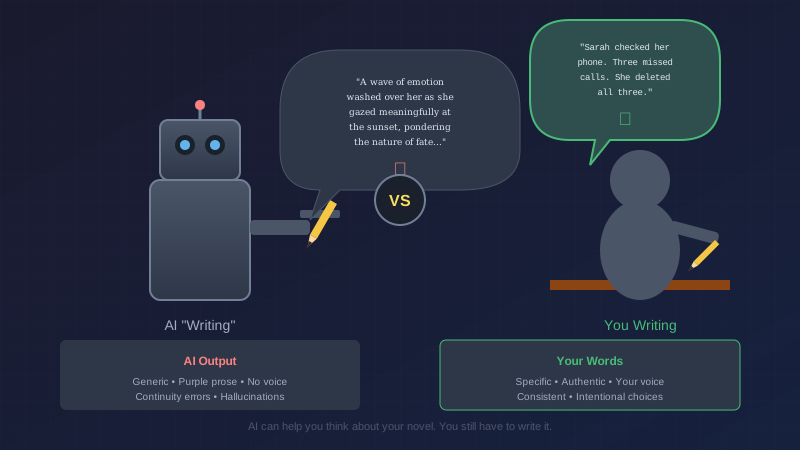
The AI gave me back a Sarah who delivered soliloquies about the nature of fate while gazing meaningfully at sunsets. Every conversation became a meditation on life's deeper meaning. It read like a romance novel written by someone who had only ever read the back covers of romance novels.
This wasn't Sarah. This was every character in every mediocre romance novel, filtered through whatever patterns the model learned from the internet's vast repository of purple prose.
But it got worse.
The Hallucination Problem
In technical AI work, "hallucination" means the model makes up facts. In fiction, hallucination means your protagonist suddenly changes careers mid-chapter because the AI thought it would "add spice."
I'm not exaggerating. I watched my main character—established as a logistics coordinator over 50,000 words—suddenly become a marine biologist. No explanation. The AI just... decided.
When I pointed this out, it apologized and fixed it. For about three paragraphs. Then she was studying tide pools again.
Maintaining continuity across even a single chapter was a constant battle. Across an entire novel? Forget it. The AI has no memory of what it wrote. Every prompt starts fresh. Every detail you've established needs to be re-established, repeatedly, or it will drift.
The Voice Problem
Voice is everything in fiction. It's what makes your work yours. It's the difference between generic prose and something that actually sounds like a specific person telling a specific story.
AI doesn't understand voice. It understands patterns.
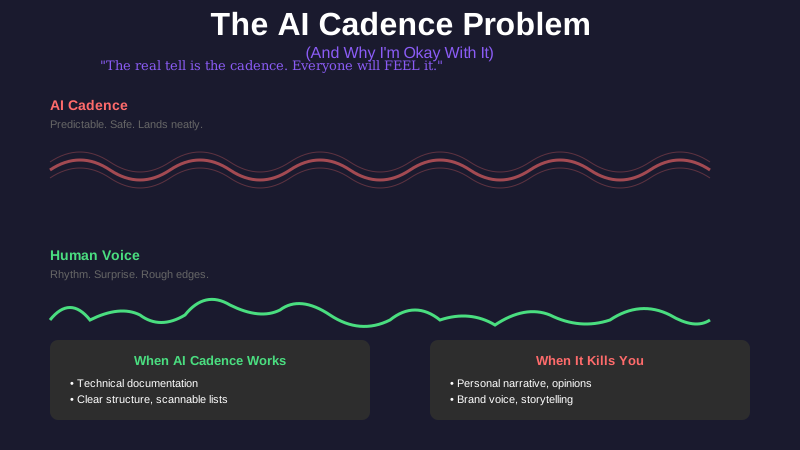
Feed it enough of your writing and it might approximate your sentence structure. But it will also smooth out the quirks. Normalize the rhythm. Default to the average of everything it's ever read.
The result reads like... nothing. Like content. Like words that technically form sentences but have no personality, no specificity, no you.
I spent more time removing AI-isms ("She felt a wave of emotion wash over her") than I would have spent just writing the scene myself.
What AI Actually Can Do
After months of frustration, I've found exactly three things AI does well for fiction:
1. Brainstorming
"I need five possible motivations for my antagonist. She's a former professor, late 50s, bitter about something but not in an obvious way."
AI will give you five ideas. Some will be terrible. Some will be clichéd. But one might spark something you hadn't considered. That's valuable.
2. Plot Hole Detection
"Here's a summary of my plot. What logical inconsistencies do you see?"
This is genuinely useful. AI will catch things like "Your character is in Chicago on Tuesday but Paris on Wednesday with no mention of travel." It's like a very literal-minded beta reader who doesn't care about your feelings.
3. "What If" Exploration
"What if the detective is wrong about the murder weapon? How might the story change?"
AI can rapidly generate alternative scenarios. You're not using the output directly—you're using it to think through possibilities faster than you could alone.
The Handholding Process
Here's what actually works, and why it's not worth it:
- Write a scene yourself
- Ask AI to review for pacing issues
- Manually fix the pacing issues (AI's suggestions are usually wrong)
- Ask AI to suggest dialogue improvements
- Ignore 90% of the suggestions because they kill your voice
- Implement the 10% that are actually useful
- Ask AI to check for continuity errors
- Fix the errors it catches
- Verify the fixes didn't introduce new errors
- Repeat forever
By the time you've handholded the AI through this process, you could have just... written the thing yourself. And it would have been better.
The Real Lesson
AI is a tool, not a collaborator.
A hammer doesn't care about your vision. It doesn't understand architecture. It just hits nails when you swing it correctly.
AI is the same. It doesn't understand your story. It doesn't know your characters. It's pattern-matching on probability distributions, generating whatever sequence of words seems statistically plausible next.
For coding, this works. Code has right answers. Patterns matter more than personality.
For fiction? The whole point is the specific voice, the particular choice, the weird detail that only you would think of. AI gives you average. Average fiction is boring. Boring fiction doesn't get read.
What I Do Now
I write my own words.
I use AI for brainstorming when I'm stuck. I use it to catch obvious errors. I use it as an extremely patient sounding board for plot problems.
But the prose? That's mine. It has to be. Because if it's not distinctly mine, why would anyone read it?
The marketing says AI can write your novel. The reality is simpler: AI can help you think about your novel. You still have to write it.
And honestly? That's okay. The writing is the point.
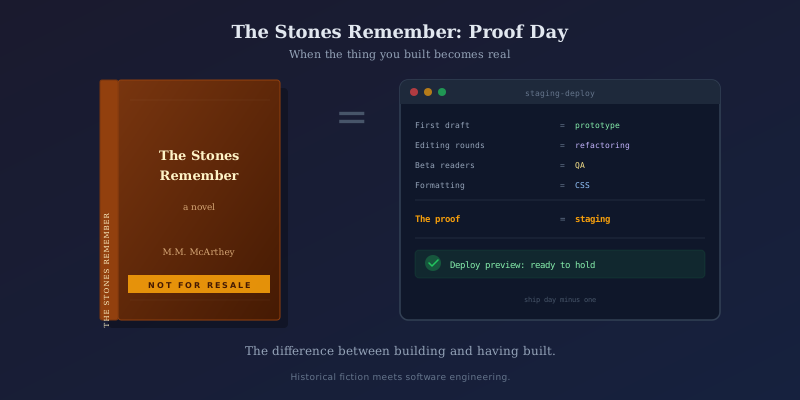
This post is part of a series on the writing journey. Currently in the middle of Novel90's Spring 2026 cohort, editing a first draft into something publishable—by hand, with minimal AI assistance, and significantly fewer soliloquies about fate. If you want to see what this editing process actually looks like in practice, The Stones Remember: Proof Day is the moment it became real.