There's a moment in every project—software or otherwise—where the thing you've been building becomes real.
In software, it's the first time your app runs on someone else's machine. The first production deployment. The first time a stranger uses something you made and it actually works.
In fiction, it's the day the proof arrives.
What's a Proof?
For non-publishing folks: a proof is a physical test copy of your book, printed exactly as the final version will look. Same cover. Same paper. Same binding. Same everything—except with a big banner that says "NOT FOR RESALE."
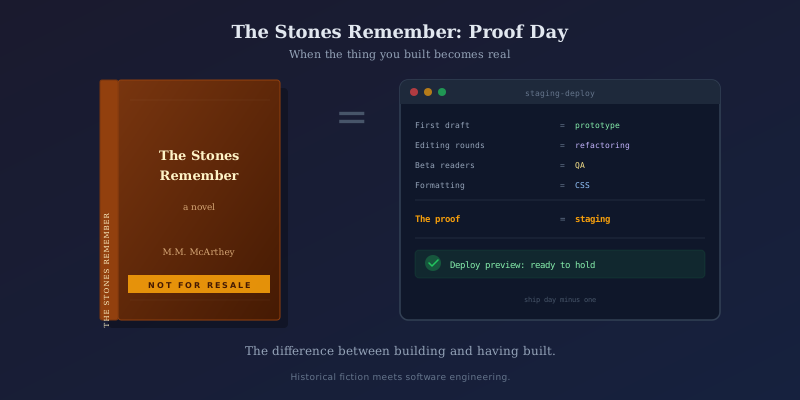
It's the book's staging environment.
You hold it. You flip through it. You check for formatting disasters—orphaned lines, weird page breaks, images that looked fine on screen but bleed wrong in print. You read passages you've read a thousand times, but they feel different now because they're on real pages bound in a real spine.
It's a deploy preview you can hold in your hands.
The Book
The Stones Remember is historical fiction set in medieval Scotland. It's been in progress for years—through job changes, moves, and life happening in the margins. Written in early mornings. Edited in late nights. Revised on weekends when I probably should have been touching grass.
It's not a technical project, but the process is surprisingly similar to building software:
- First draft = Prototype. It works, barely. The architecture is questionable. You're embarrassed by the early commits but they got you here.
- Editing rounds = Refactoring. Same story, better structure. Tighten the pacing. Kill your darlings (delete that clever scene that doesn't serve the narrative, just like deleting that clever abstraction that doesn't serve the code).
- Beta readers = QA. Real humans finding the bugs you're too close to see. "This character disappeared for three chapters and nobody noticed." "This timeline doesn't add up."
- Formatting = The CSS of publishing. It shouldn't matter this much, but it absolutely does. Margins, font size, chapter headers, page numbers—the invisible scaffolding that makes reading feel effortless.
- The proof = Staging deployment. One final check before the real thing.
Why It Matters on a Tech Blog
This blog is about building things. Usually those things are software—APIs, databases, deployment pipelines, LLM integrations. But the builder mindset doesn't shut off when you close the IDE.
Writing fiction uses the same muscles: planning a complex system (plot), managing state across components (character arcs), handling edge cases (what would this character actually do here?), and shipping something that works as a coherent whole.
The proof sitting on my desk is a reminder that projects finish. Not quickly, not easily, not without bugs—but they finish.
The Feeling
I won't pretend this is some profound revelation. But holding a physical book you wrote is different from seeing it on a screen. It has weight. It smells like paper and ink. The cover art wraps around a spine with your name on it.
It's the difference between localhost:5000 and yourdomain.com. Between a green CI pipeline and a customer saying "this is great." Between building and having built.
Proof day is ship day minus one. And it feels pretty good.
The Stones Remember by M.M. McArthey — coming soon.
If you're curious where this story started, How Black Ember Began (Or: From Video Game Avatar to Literary Fiction) is the origin story.
Back to our regularly scheduled programming (literally) in the next post.