I've taught REST APIs to hundreds of students. The conversation always goes the same way:
Me: "Today we're learning REST APIs."
Student: "What's a REST API?"
Me: "A way for applications to talk to each other using HTTP."
Student: "Okay... why do I care?"
And that's the problem. Not the explanation. The motivation.
Students don't care about HTTP verbs in the abstract. They care when there's a reason to use them.
That's why I built API Combat—an API-only game designed specifically for teaching.
The Problem With Traditional API Tutorials
Most API courses follow this pattern:
- Explain HTTP methods (GET, POST, PUT, DELETE)
- Explain JSON structure
- Build a todo API
- Build a blog API
- Build another CRUD API
Students learn the mechanics. But they're bored.
Because todo lists don't inspire. Blog backends don't excite. CRUD operations don't challenge.
They complete the assignment. They pass the test. They forget everything two weeks later.
What If Learning Felt Like Play?
API Combat flips the script:
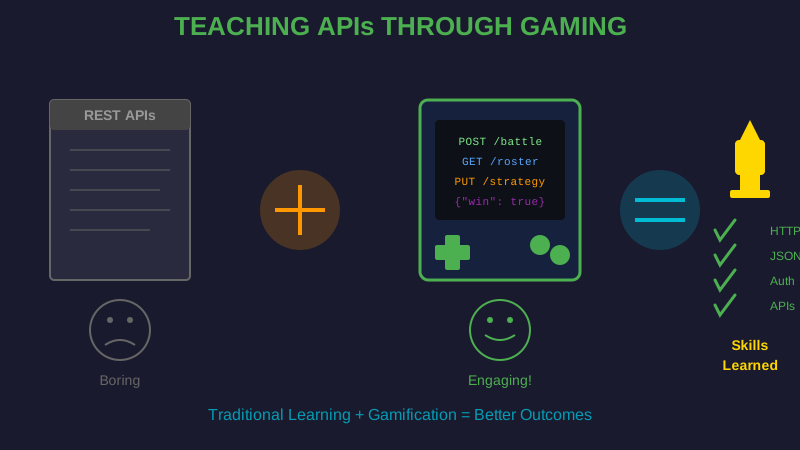
Assignment: "Build a client that battles other students' bots. Whoever climbs highest on the leaderboard wins."
Suddenly:
- Learning curl isn't a chore—it's a weapon
- Parsing JSON isn't busywork—it's intelligence gathering
- Writing Python scripts isn't homework—it's strategy automation
Same technical concepts. Different motivation.
What Students Actually Learn
When students build API Combat clients, they learn:
1. HTTP Methods (By Necessity)
- GET
/api/v1/player/roster→ "I need to see my units" - POST
/api/v1/strategies/upload→ "I need to configure my team" - POST
/api/v1/battle/queue→ "I need to start a fight" - GET
/api/v1/battle/results/{id}→ "I need to see what happened"
They're not learning HTTP verbs for a grade. They're using them to win battles.
2. Authentication & Security
Every request requires a JWT token. Students learn:
- Bearer token headers
- Token expiration handling
- Refresh token flows
- API key management (don't commit tokens to GitHub!)
Not because I lectured them. Because their bot won't work without proper auth.
3. JSON Structure & Serialization
Strategies are JSON documents. Students learn:
- Object nesting (
formation.frontLine,tactics.targetPriority) - Arrays of objects (
units[],abilities[]) - Serialization (Python dict → JSON string)
- Deserialization (API response → usable data)
Because their battle strategy is literally a JSON file they write and upload.
4. Error Handling
{
  "error": "Invalid strategy",
  "code": "VALIDATION_ERROR",
  "details": {
    "field": "formation.frontLine",
    "message": "Front line must have 2-3 units"
  }
}
Students learn:
- HTTP status codes (400, 401, 403, 429, 500)
- Error response parsing
- Retry logic for rate limits
- Graceful degradation
Not from slides. From failing API calls and debugging them.
5. Async Programming
Battles aren't instant. Students learn:
- Async requests (queue battle → poll for results)
- Webhooks (battle completion notifications)
- Polling patterns (check status, handle "not ready yet")
Because they want results fast, and the API forces async patterns.
6. Rate Limiting
Free tier: 60 requests/minute. Premium: 120 requests/minute. Premium+: 300 requests/minute.
Students learn:
- Exponential backoff
- Request throttling
- Batch operations (queue 10 battles vs 1 at a time)
Not from theory. From hitting 429 Too Many Requests and figuring out why.
How to Use API Combat in Your Curriculum
Week 1: Basics (Manual API Calls)
Assignment: Register an account and queue your first battle using curl.
What they learn:
- Making POST requests
- Handling JSON payloads
- Reading API documentation
- Bearer token authentication
Success metric: They queue a battle and retrieve results.
Week 2: Automation (Build a Bot)
Assignment: Write a Python script that auto-battles 10 times and logs results.
What they learn:
- Using
requestslibrary - Looping through API calls
- Parsing JSON responses
- File I/O (logging battle results)
Success metric: Their bot completes 10 battles without manual intervention.
Week 3: Strategy Optimization
Assignment: Create 3 different strategies and test which wins most often.
What they learn:
- POST strategy configurations
- A/B testing via code
- Data analysis (win rate calculations)
- Iteration and optimization
Success metric: They identify which strategy performs best and explain why.
Week 4: Advanced Features (Premium Tier)
Assignment: Use the simulation endpoint to test 1000 battles. Analyze results.
What they learn:
- Batch operations
- Data aggregation
- Statistical analysis
- API performance optimization
Success metric: They run simulations and present findings.
Week 5: Tournament & Presentation
Assignment: Class-wide tournament. Best bot wins. Present your approach.
What they learn:
- Everything above, applied under pressure
- Competitive optimization
- Code collaboration (guild features)
- Presentation skills (explain their approach)
Success metric: Fully functional bot that competes autonomously, plus a team presentation explaining architecture decisions and results.
Education Mode Features
I built Education Mode specifically for classrooms:
1. Class-Scoped Tournaments & Leaderboards
Run tournaments within your class. Class-specific leaderboards keep competition focused and meaningful. Top students get bragging rights (and extra credit, your call).
2. Progress Tracking
View every student's:
- Lesson completion progress
- Per-lesson completion rates
- Enrollment status
- Recent activity
3. Instructor-Defined Curriculum Modules
Create lesson sequences tied to specific API endpoints with verification steps that confirm students have completed each objective.
4. Team Battles (Guild Wars)
Split class into teams. Collaborative assignments:
- Share strategies via GitHub
- Coordinate attacks in guild wars
- Peer code review
Why This Works
Traditional assignments create extrinsic motivation:
- "Do this for a grade"
- "Complete these requirements"
- "Submit by Friday"
API Combat creates intrinsic motivation:
- "I want to beat my classmates"
- "I want to optimize my win rate"
- "I want to climb the leaderboard"
Same learning outcomes. Different drive.
How to Get Started
1. Sign Up for Education Mode
Contact me for early access. Include:
- Institution name
- Course details
- Expected class size
- Semester dates
I'll set up a private instance for your class.
2. Assign the Tutorial
Point students to: Your First Battle: A Complete Walkthrough
Everyone starts with the same 5 units. Level playing field.
3. Define Milestones
Week-by-week progression (suggested above) or custom assignments.
4. Run Tournaments
Mid-term tournament. Final tournament. Winner gets glory.
5. Showcase Projects
Best bots get featured on the API Combat blog. Students love this.
Pricing for Educators
Education Mode is free for accredited institutions (K-12, universities, bootcamps).
Why free?
Because if API Combat helps students learn, that's success. If some become lifelong players/subscribers after graduation, that's how I monetize.
I'd rather have 1000 students learn well than charge schools $500/semester.
Comparison to Alternatives
API Combat vs CRUD Tutorials
| Feature | CRUD Tutorial | API Combat |
|---|---|---|
| Engagement | Low (repetitive) | High (competitive) |
| Motivation | Extrinsic (grade) | Intrinsic (winning) |
| Collaboration | Rare | Built-in (guilds) |
| Real-world skills | Basic | Advanced (webhooks, async, rate limiting) |
API Combat vs Existing Games
| Game | API-First? | Educational? | Scalable? |
|---|---|---|---|
| Screeps | Partially (JavaScript required) | Moderate | Yes |
| CodeCombat | No (UI-first, scripting optional) | Yes | Yes |
| Robocode | No (Java required, local battles) | Moderate | No |
| API Combat | Yes (API-only, any language) | Yes | Yes |
API Combat is the only game that:
- Requires zero client downloads
- Works with any programming language
- Is designed for REST API learning specifically
- Scales to classroom tournaments
What You Don't Need
- No special software - Students use curl, Postman, or code
- No setup time - Accounts created via API in 30 seconds
- No infrastructure - I host everything
- No game design skills - I built the game, you teach the concepts
You just need: A syllabus and students who want to win.
Get Started This Semester
If you're teaching APIs this semester, try API Combat:
- Contact me for Education Mode access
- Assign the tutorial as Week 1 homework
- Run your first class tournament Week 4
- Watch engagement skyrocket
I'll support you with:
- Custom challenges for your curriculum
- Progress tracking dashboards
- Tournament logistics
- Student showcase opportunities
Let's make API learning fun.
Educators: Request Education Mode access: learnedgeek.com/Contact
Students: Want to try it on your own? Sign up free
Curious? Read the full tutorial: Your First Battle
This post is part of a series about building API Combat. See also: HATEOAS-Lite: Making a Discoverable API for how the API teaches itself to players, Custom API Docs: Ditching Swagger for why documentation is part of the gameplay, and Elo Rating + Seasonal Tiers for the competitive ranking system that drives student engagement.
Co-Authored-By: Claude Sonnet 4.5 [email protected]