You type something into Google. In a fraction of a second, you get a list of websites. But how? The internet has billions of pages. How does Google know they exist? How does it decide which ones to show first?
The answer involves robot spiders, giant indexes, and a lot of math. But you don't need to be a programmer to understand it. This is search engines explained for everyone.
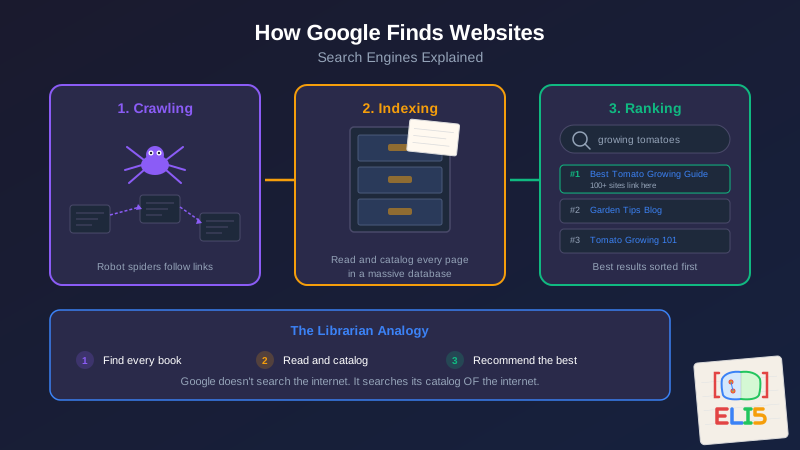
The Librarian Problem
Imagine the world's largest library. Billions of books. No catalog. No organization. Just books piled everywhere, and more arriving every second.
Now imagine someone walks in and asks: "I need information about growing tomatoes."
How would you help them?
You'd need to:
- Know what books exist — somehow find and record every book in the library
- Know what each book is about — read them all and summarize the contents
- Decide which ones are best — figure out which tomato books are actually helpful
That's exactly what Google does, but for the entire internet.
Step 1: Crawling (The Robot Spiders)
Google uses programs called crawlers (or "spiders" or "bots") that visit websites automatically. The most famous is called Googlebot.
Here's what Googlebot does:
- Starts at a known website
- Downloads the page
- Finds all the links on that page
- Visits each linked page
- Repeats forever
It's like exploring a cave system. You enter one cave, find tunnels leading to other caves, follow those tunnels, find more tunnels, and keep going.
Because websites link to each other, Googlebot can discover most of the internet just by following links. It's been doing this since 1998, and it never stops.
New page goes live? If another website links to it, Googlebot will eventually find it. Could be hours, could be weeks—but it'll find it.
Step 2: Indexing (The Giant Catalog)
Visiting pages is one thing. Remembering them is another.
After Googlebot downloads a page, Google indexes it—adds it to a massive database (the "index") that records:
- What's the URL?
- What text is on the page?
- What's the title?
- What images are there?
- When was it last updated?
- What other pages link here?
- What topics does it seem to be about?
Think of indexing as Google reading the book and writing an index card with a summary. That index card goes into the catalog.
Google's index is absurdly large. Hundreds of billions of pages. Many petabytes of data. It's the most comprehensive catalog of human knowledge ever created.
Step 3: Ranking (The Sorting Hat)
Here's where the magic happens.
You search for "growing tomatoes." Google's index contains millions of pages that mention tomatoes. Which ten should appear first?
This is the ranking problem, and it's what made Google famous.
Before Google, search engines mostly ranked by keywords. If a page said "tomatoes" a lot, it ranked higher. This was easy to game—just stuff keywords everywhere.
Google's breakthrough was PageRank: instead of trusting what pages say about themselves, look at what other pages say about them. If lots of respected websites link to a page, that page is probably valuable.
It's like academic citations. A paper cited by hundreds of researchers is probably more important than one nobody references.
Modern Google ranking considers hundreds of factors:
- How many quality sites link to this page?
- Is the content original or copied?
- How fast does the page load?
- Does it work well on mobile phones?
- How long do visitors stay before leaving?
- Is the website secure (HTTPS)?
- Does the content match what the searcher wants?
All of these factors combine into a score. The highest-scoring pages appear first.
What "SEO" Actually Means
SEO stands for "Search Engine Optimization." It's the practice of making your website easier for Google to find, understand, and recommend.
This isn't manipulation—it's communication. You're helping Google understand:
- What your page is about (through titles, headings, and text)
- That your content is valuable (by earning links from other sites)
- That your site works well (fast loading, mobile-friendly, secure)
Good SEO is like good packaging. The product matters most, but clear labeling helps customers find it.
Common SEO Misconceptions
"Keywords are everything" — They matter, but keyword stuffing backfires. Write naturally for humans.
"You can pay for better rankings" — Not in the regular results. Those are organic. The ads at the top are paid, and they're labeled.
"More pages = better" — Quality beats quantity. One excellent page outranks a hundred thin ones.
"SEO is a one-time thing" — It's ongoing. The internet changes. Competitors improve. Google updates its algorithms.
"Social media followers improve ranking" — Not directly. Social shares might lead to links, which do help. But followers alone don't move the needle.
Why Your Site Might Be Invisible
If Google can't find your site, a few common culprits:
No incoming links: If no other website links to you, Googlebot might never discover you. The crawlers follow links—no links, no visits.
Blocking the crawlers: A misconfigured file (robots.txt) can accidentally tell Googlebot to stay away.
Too new: Google might just not have gotten to you yet. Patience—and maybe register with Google Search Console to speed things up.
Technical problems: Broken code, slow loading, or weird redirects can prevent proper indexing.
Thin content: If your pages don't have much unique content, Google might not see them as worth indexing.
The Search Quality Team
Google employs thousands of people focused on search quality. Their job: make sure the top results are actually the best results.
They write guidelines for what "good" pages look like. They test algorithm changes on small samples before rolling them out. They fight spam and manipulation.
When Google updates its ranking algorithm (which happens constantly), some websites rise and others fall. Sites that were gaming the system often get penalized. Sites with genuinely helpful content usually do fine.
The Bigger Picture
Search engines are the card catalogs of the internet age. They make the sum of human knowledge searchable in milliseconds.
Every time you Google something and find the answer, this whole system fires:
- Your query goes to Google's servers
- The index is searched for matching pages
- Hundreds of ranking factors are calculated
- The best pages are returned to you
- All in under a second
It's infrastructure we take for granted, but it's one of the most remarkable engineering achievements in history.
The Simple Takeaway
- Crawlers are robot spiders that visit websites by following links
- Indexing is recording what's on each page in a giant database
- Ranking is deciding which pages are best for a given search
- SEO is helping Google understand your content
- Links from other sites are like votes of confidence
- Quality content is still the foundation of everything
When you create something valuable, share it, get others to link to it, and make sure your website works well technically—that's SEO. Everything else is details.
This is part of the ELI5 series—technical concepts explained without the jargon. For technical SEO implementation guides, see SEO Demystified and Google Search Console Setup.
The internet is vast. Search engines are how we navigate it. Understanding them helps you be found.