Your app logs an error. You show the user a reference ID so they can call support:
Error Reference: 7f3a91b0-4c2e-4d8f-a1b3-9c0d1e2f3a4b
The user calls and tries to read it over the phone:
"Seven... eff... three... ay... nine... one... bee... zero... wait, was that a zero or the letter O? And is that a one or a lowercase L?"
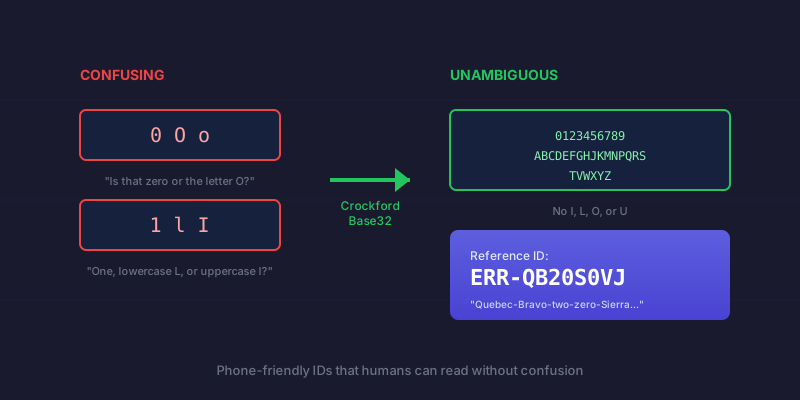
This is a disaster. GUIDs, hex strings, and base64 all have characters that sound alike or look alike. When humans communicate these IDs verbally or type them on a phone keyboard, errors multiply.
Douglas Crockford's Solution
Douglas Crockford (of JSON fame) designed a Base32 encoding specifically for human readability. His insight: exclude characters that humans confuse.
The Crockford Base32 Alphabet
0 1 2 3 4 5 6 7 8 9 A B C D E F G H J K M N P Q R S T V W X Y Z
Notice what's missing:
- I — Looks like
1(one) andl(lowercase L) - L — Looks like
1(one) andI(uppercase i) - O — Looks like
0(zero) - U — Sounds like "you" and can be confused with
V
The Difference Over the Phone
| Encoding | ID | Phone Confusion |
|---|---|---|
| Hex | A1B0C10D |
"Is that one-zero or I-O? And a one or an L?" |
| Base64 | QWxhZGRpbg== |
"Uppercase or lowercase? Plus or equals?" |
| Crockford | REF-ABCD5678 |
"Romeo-Echo-Foxtrot-dash-Alfa-Bravo-Charlie-Delta-five-six-seven-eight" |
The Crockford ID is unambiguous. No zero that looks like O, no one that looks like L.
Implementation
Here's a C# implementation for generating support-friendly reference IDs:
public static class ReferenceIdGenerator
{
    // Crockford's Base32 alphabet - excludes I, L, O, U
    private const string Alphabet = "0123456789ABCDEFGHJKMNPQRSTVWXYZ";

    private static readonly Random _random = new();
    private static readonly object _lock = new();

    public static string Generate(string prefix = "REF")
    {
        var chars = new char[8];

        lock (_lock)
        {
            for (int i = 0; i < 8; i++)
            {
                chars[i] = Alphabet[_random.Next(Alphabet.Length)];
            }
        }

        return $"{prefix}-{new string(chars)}";
    }

    public static bool IsValid(string? referenceId, string prefix = "REF")
    {
        if (string.IsNullOrEmpty(referenceId))
            return false;

        if (!referenceId.StartsWith($"{prefix}-"))
            return false;

        var expectedLength = prefix.Length + 1 + 8; // prefix + dash + 8 chars
        if (referenceId.Length != expectedLength)
            return false;

        var suffix = referenceId.Substring(prefix.Length + 1);
        return suffix.All(c => Alphabet.Contains(c));
    }

    /// <summary>
    /// Normalizes user input - handles common mistypes.
    /// Crockford spec allows treating I/L as 1 and O as 0.
    /// </summary>
    public static string Normalize(string input)
    {
        return input.ToUpperInvariant()
            .Replace('I', '1')
            .Replace('L', '1')
            .Replace('O', '0');
    }
}
The Prefix Matters
Using a prefix like REF- or ERR- has several benefits:
- Identification — Support knows immediately what system it's from
- Searchability — Easy to grep logs:
grep "ERR-" - User confidence — Users know they're reading the right thing
- Disambiguation — Won't be confused with other IDs in the system
Different contexts might use different prefixes:
ERR-for errorsTKT-for support ticketsORD-for order numbersINV-for invite codes
Entropy and Uniqueness
With 8 characters from a 32-character alphabet:
32^8 = 1,099,511,627,776 possible combinations (~1.1 trillion)
For a logging system generating thousands of IDs per day, this is more than sufficient. You'd need to generate 1 million IDs per second for 12 days to have a 50% chance of collision.
Need more entropy? Extend to 10 characters (32^10 ≈ 1 quadrillion).
The Phone Support Flow
Here's how this plays out in practice:
User's screen:
Something went wrong

Reference ID: ERR-QB20S0VJ

Provide this ID when contacting support.
Support call:
User: "I got an error, the code is Echo-Romeo-Romeo-dash-Quebec-Bravo-two-zero-Sierra-zero-Victor-Juliet"
Support: types ERR-QB20S0VJ "Got it, let me look that up..."
No ambiguity. The user can even use NATO phonetic alphabet naturally because there's no I, L, O, or U to confuse things.
Handling User Mistakes
Even with Crockford encoding, users might still type O instead of 0. The spec allows for this—implement a normalizer:
// User types: "ERR-QB2OS0VJ" (accidentally typed O instead of 0)
var normalized = ReferenceIdGenerator.Normalize("ERR-QB2OS0VJ");
// Result: "ERR-QB20S0VJ" (O converted to 0)
This forgiveness makes support lookups more reliable.
Testing
public class ReferenceIdGeneratorTests
{
    [Fact]
    public void Generate_ReturnsCorrectFormat()
    {
        var id = ReferenceIdGenerator.Generate("ERR");

        Assert.StartsWith("ERR-", id);
        Assert.Equal(12, id.Length); // "ERR-" + 8 chars
    }

    [Fact]
    public void Generate_OnlyUsesCrockfordCharacters()
    {
        var id = ReferenceIdGenerator.Generate();
        var suffix = id.Split('-')[1];

        Assert.DoesNotContain("I", suffix);
        Assert.DoesNotContain("L", suffix);
        Assert.DoesNotContain("O", suffix);
        Assert.DoesNotContain("U", suffix);
    }

    [Theory]
    [InlineData("ct-abcd5678", "CT-ABCD5678")]
    [InlineData("CT-ABCDIO78", "CT-ABCD1078")]  // I->1, O->0
    [InlineData("CT-ABCDLO78", "CT-ABCD1078")]  // L->1, O->0
    public void Normalize_ConvertsCorrectly(string input, string expected)
    {
        Assert.Equal(expected, ReferenceIdGenerator.Normalize(input));
    }
}
Beyond Error Codes
This pattern works for any human-communicated identifier:
- Confirmation codes — "Your confirmation is CONF-HX7P2QRM"
- Invite codes — "Join with code TEAM-N4K8VW3D"
- Short URLs —
myapp.com/j/QB20S0VJ - Device pairing — "Enter code: PAIR-5M9THWKQ"
Anywhere humans read, speak, or type IDs, Crockford Base32 reduces errors.
Key Takeaways
- Design for humans — Encoding isn't just about efficiency; it's about usability
- Phone support is real — Users will read codes over the phone
- Forgiveness matters — Normalize input to handle common mistakes
- Prefixes help — Make IDs self-identifying
- Douglas Crockford was right — Sometimes the best solution is removing the problem characters entirely
Small design choices make big differences in real-world support. When a user's app crashes and they need help, the last thing they should struggle with is reading the error code.
Further Reading
- Douglas Crockford's Base32 Specification
- RFC 4648 - Base Encodings (standard Base32, not as human-friendly)
Related Posts
- Error Boundaries That Don't Trap Users — Where these reference IDs get displayed to users
- Tracer Bullet Development: Prove Your Pipeline — How error logging with reference IDs proved the architecture