Every time I start a new .NET project, I find myself hunting through old projects to copy the tasks.json configuration. This post documents the setup I use so I can find it in one place.
What tasks.json Does
VS Code's tasks.json file (in the .vscode folder) defines custom tasks that run from the Command Palette (Ctrl+Shift+P → "Run Task") or via keyboard shortcuts. For .NET projects, this typically means:
- Building the solution
- Running one or more projects simultaneously
- Running tests
- Building CSS (for projects using Tailwind or similar)
- Publishing to staging and production environments
- Orchestrating all of the above with a single command
The Full Configuration
Here's my current tasks.json for a multi-project ASP.NET solution with Tailwind CSS, multiple deployment environments, and Web Deploy publishing:
{
    "version": "2.0.0",
    "inputs": [
        {
            "id": "deployPassword",
            "type": "promptString",
            "description": "Enter deployment password",
            "password": true
        }
    ],
    "tasks": [
        {
            "label": "Build",
            "command": "dotnet",
            "type": "process",
            "args": [
                "build",
                "${workspaceFolder}/ProjectName.sln",
                "/property:GenerateFullPaths=true",
                "/consoleloggerparameters:NoSummary"
            ],
            "problemMatcher": "$msCompile",
            "group": {
                "kind": "build",
                "isDefault": true
            }
        },
        {
            "label": "Test",
            "type": "process",
            "command": "dotnet",
            "args": [
                "test",
                "${workspaceFolder}/ProjectName.sln"
            ],
            "problemMatcher": "$msCompile",
            "group": "test"
        },
        {
            "label": "Update Browserslist",
            "type": "shell",
            "command": "npx",
            "args": ["update-browserslist-db@latest"],
            "options": {
                "cwd": "${workspaceFolder}/ProjectName.Web"
            },
            "problemMatcher": []
        },
        {
            "label": "Build CSS",
            "type": "shell",
            "command": "npm",
            "args": ["run", "build:css"],
            "options": {
                "cwd": "${workspaceFolder}/ProjectName.Web"
            },
            "dependsOn": ["Update Browserslist"],
            "problemMatcher": []
        },
        {
            "label": "Watch CSS",
            "type": "shell",
            "command": "npm",
            "args": ["run", "watch:css"],
            "options": {
                "cwd": "${workspaceFolder}/ProjectName.Web"
            },
            "isBackground": true,
            "problemMatcher": [],
            "presentation": {
                "reveal": "always",
                "panel": "dedicated"
            }
        },
        {
            "label": "Run: API",
            "type": "process",
            "command": "dotnet",
            "args": [
                "run",
                "--no-build",
                "--project",
                "${workspaceFolder}/ProjectName.Api/ProjectName.Api.csproj",
                "--launch-profile", "http"
            ],
            "dependsOn": ["Build"],
            "isBackground": true,
            "problemMatcher": [],
            "presentation": {
                "reveal": "always",
                "panel": "dedicated",
                "group": "dev"
            }
        },
        {
            "label": "Run: Web",
            "type": "process",
            "command": "dotnet",
            "args": [
                "run",
                "--no-build",
                "--project",
                "${workspaceFolder}/ProjectName.Web/ProjectName.Web.csproj",
                "--launch-profile", "http"
            ],
            "dependsOn": ["Build", "Build CSS"],
            "isBackground": true,
            "problemMatcher": [],
            "presentation": {
                "reveal": "always",
                "panel": "dedicated",
                "group": "dev"
            }
        },
        {
            "label": "Start: Dev Environment",
            "dependsOn": [
                "Run: API",
                "Run: Web",
                "Watch CSS"
            ],
            "problemMatcher": []
        },
        {
            "label": "Deploy: Staging",
            "type": "shell",
            "command": "dotnet",
            "args": [
                "publish",
                "${workspaceFolder}/ProjectName.Web/ProjectName.Web.csproj",
                "-c", "Release",
                "/p:VersionSuffix=beta",
                "/p:PublishProfile=Staging",
                "/p:Password=${input:deployPassword}"
            ],
            "dependsOn": ["Build CSS"],
            "problemMatcher": "$msCompile",
            "presentation": {
                "reveal": "always",
                "panel": "shared"
            }
        },
        {
            "label": "Deploy: Production",
            "type": "shell",
            "command": "dotnet",
            "args": [
                "publish",
                "${workspaceFolder}/ProjectName.Web/ProjectName.Web.csproj",
                "-c", "Release",
                "/p:VersionSuffix=",
                "/p:PublishProfile=Production",
                "/p:Password=${input:deployPassword}"
            ],
            "dependsOn": ["Build CSS"],
            "problemMatcher": "$msCompile",
            "presentation": {
                "reveal": "always",
                "panel": "shared"
            },
            "group": "build"
        },
        {
            "label": "Git: Create and Push Version Tag",
            "type": "shell",
            "command": "powershell",
            "args": [
                "-Command",
                "$v = ([xml](Get-Content '${workspaceFolder}/ProjectName.Web/ProjectName.Web.csproj')).Project.PropertyGroup.Version | Where-Object { $_ }; git tag -a \"v$v\" -m \"Release v$v\" && git push origin \"v$v\""
            ],
            "problemMatcher": []
        }
    ]
}
Key Concepts
Inputs for Secrets
The inputs array defines values prompted at runtime:
"inputs": [
    {
        "id": "deployPassword",
        "type": "promptString",
        "description": "Enter deployment password",
        "password": true
    }
]
Reference it in tasks with ${input:deployPassword}. The password: true flag masks input.
This keeps credentials out of the file while still enabling one-command deployment.
Task Dependencies
The dependsOn property chains tasks:
{
    "label": "Run: Web",
    "dependsOn": ["Build", "Build CSS"],
    ...
}
The "Run: Web" task automatically runs "Build" and "Build CSS" first. When a task has multiple dependencies, they run in parallel by default.
If you need dependencies to run sequentially, add dependsOrder:
{
    "label": "Deploy: Production (with Tag)",
    "dependsOn": [
        "Deploy: Production",
        "Git: Create and Push Version Tag"
    ],
    "dependsOrder": "sequence",
    "problemMatcher": []
}
Without "sequence", both would kick off at the same time — bad news if you want the deploy to succeed before tagging.
Build Once, Run Many
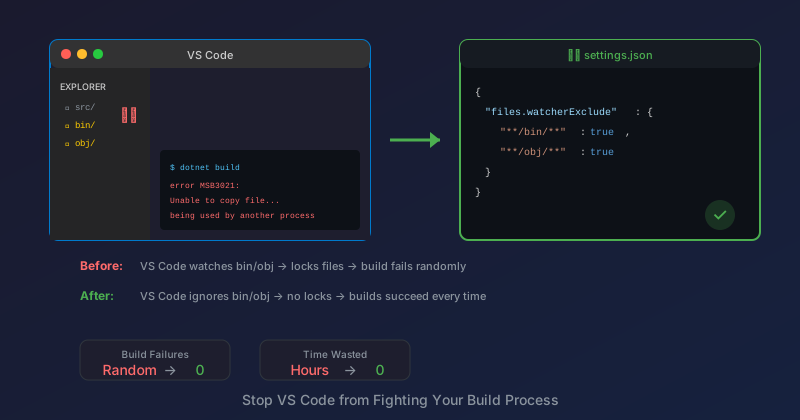
When a compound task fans out to start multiple .NET projects simultaneously, each dotnet run will try to build the solution. Two builds running against the same solution at the same time means file locks and build failures.
The fix: build once explicitly, then run each project with --no-build:
{
    "label": "Run: API",
    "args": [
        "run",
        "--no-build",
        "--project",
        "${workspaceFolder}/ProjectName.Api/ProjectName.Api.csproj"
    ],
    "dependsOn": ["Build"],
    ...
}
The dependsOn guarantees the build completes first. The --no-build flag tells dotnet run to skip the build step and use whatever was already compiled. No race conditions, no file locks.
Compound Tasks
Tasks with only dependsOn and no command of their own act as orchestrators:
{
    "label": "Start: Dev Environment",
    "dependsOn": [
        "Run: API",
        "Run: Web",
        "Watch CSS"
    ],
    "problemMatcher": []
}
One command in the palette, three services running. Each gets its own terminal panel.
This pattern scales well for deployment too — a "Deploy: All Staging" task can fan out to deploy both a web app and an API in parallel, or a "Deploy: All Production (with Tag)" task can deploy, then tag the release.
Better Build Output
Two build args that improve the VS Code experience:
"args": [
    "build",
    "${workspaceFolder}/ProjectName.sln",
    "/property:GenerateFullPaths=true",
    "/consoleloggerparameters:NoSummary"
]
GenerateFullPaths=true— Makes build errors include the full file path instead of a relative one. This means the$msCompileproblem matcher can turn every error into a clickable link that jumps straight to the file and line.NoSummary— Suppresses the "Build succeeded" summary block at the end. Reduces noise when you're chaining builds into other tasks.
Keeping Browserslist Updated
If you use Tailwind CSS with PostCSS, you'll eventually see this warning during builds:
Browserslist: caniuse-lite is outdated. Please run:
  npx update-browserslist-db@latest
Rather than running this manually, add a task that runs automatically before CSS builds:
{
    "label": "Update Browserslist",
    "type": "shell",
    "command": "npx",
    "args": ["update-browserslist-db@latest"],
    "options": {
        "cwd": "${workspaceFolder}/ProjectName.Web"
    },
    "problemMatcher": []
}
Then chain it to your CSS build task:
{
    "label": "Build CSS",
    "dependsOn": ["Update Browserslist"],
    ...
}
Now every CSS build ensures the browserslist database is current. The update is fast when already current, so it doesn't add noticeable overhead.
Problem Matchers
Problem matchers parse task output and populate VS Code's Problems panel:
"problemMatcher": "$msCompile"
The $msCompile matcher understands .NET compiler output, so build errors become clickable links to the source. Pair this with GenerateFullPaths=true on your build task for the best results.
For tasks that don't produce parseable errors (like npm scripts), use an empty array:
"problemMatcher": []
Background Tasks and Presentation
For long-running watchers and servers, two properties control the terminal behavior:
{
    "label": "Run: API",
    "isBackground": true,
    "presentation": {
        "reveal": "always",
        "panel": "dedicated",
        "group": "dev"
    }
}
isBackground: true— Tells VS Code this task doesn't terminate. Without this, VS Code would show a spinner waiting for the task to "finish."panel: "dedicated"— Gives the task its own terminal instead of sharing one with other tasks.group: "dev"— Groups related terminals together in VS Code's terminal panel. All tasks with"group": "dev"appear as tabs in the same panel, making it easy to switch between your API and Web server output.
For tasks you want to launch silently (like starting an emulator), use "reveal": "silent" so they don't steal focus.
Task Groups
Groups organize tasks in the Command Palette:
"group": {
    "kind": "build",
    "isDefault": true
}
The default build task runs with Ctrl+Shift+B.
Working Directory
For tasks that need to run in a subdirectory:
"options": {
    "cwd": "${workspaceFolder}/ProjectName.Web"
}
This is necessary when package.json lives in the project folder rather than the solution root.
Launch Profiles
The --launch-profile flag tells dotnet run which profile from launchSettings.json to use:
"args": [
    "run",
    "--no-build",
    "--project", "...",
    "--launch-profile", "http"
]
This is useful when you have multiple profiles (http, https, IIS Express) and want tasks to consistently use the same one.
Publishing with Web Deploy
Multiple Environments
Separate tasks for staging and production keep deployments intentional:
{
    "label": "Deploy: Staging",
    "args": [
        "publish", "...",
        "-c", "Release",
        "/p:VersionSuffix=beta",
        "/p:PublishProfile=Staging",
        "/p:Password=${input:deployPassword}"
    ],
    "dependsOn": ["Build CSS"]
}
{
    "label": "Deploy: Production",
    "args": [
        "publish", "...",
        "-c", "Release",
        "/p:VersionSuffix=",
        "/p:PublishProfile=Production",
        "/p:Password=${input:deployPassword}"
    ],
    "dependsOn": ["Build CSS"]
}
The key differences between environments:
PublishProfile— Points to a different.pubxmlfile for each environment, with different server URLs and site paths.VersionSuffix— Staging getsbeta(producing versions like1.2.0-beta), while production sets it to empty for clean release versions (1.2.0). This works with the<VersionPrefix>in your.csprojfile.
For multi-project solutions (separate Web and API deployments), add compound tasks to deploy everything at once:
{
    "label": "Deploy: All Staging",
    "dependsOn": [
        "Deploy: Staging Web",
        "Deploy: Staging API"
    ],
    "problemMatcher": []
}
The password input is prompted once and reused across both deploy tasks in the same session.
Publish Profile Setup
The .pubxml file in Properties/PublishProfiles/ contains:
<?xml version="1.0" encoding="utf-8"?>
<Project>
  <PropertyGroup>
    <WebPublishMethod>MSDeploy</WebPublishMethod>
    <PublishProvider>AzureWebSite</PublishProvider>
    <LastUsedBuildConfiguration>Release</LastUsedBuildConfiguration>
    <LastUsedPlatform>Any CPU</LastUsedPlatform>
    <SiteUrlToLaunchAfterPublish>https://yoursite.com/</SiteUrlToLaunchAfterPublish>
    <LaunchSiteAfterPublish>false</LaunchSiteAfterPublish>
    <MSDeployServiceURL>yourhost.com</MSDeployServiceURL>
    <DeployIisAppPath>yoursite.com</DeployIisAppPath>
    <RemoteSitePhysicalPath />
    <SkipExtraFilesOnServer>false</SkipExtraFilesOnServer>
    <MSDeployPublishMethod>WMSVC</MSDeployPublishMethod>
    <EnableMSDeployBackup>true</EnableMSDeployBackup>
    <UserName>deployuser</UserName>
  </PropertyGroup>
</Project>
The password is passed via /p:Password= at publish time because Web Deploy publish profiles don't store passwords.
Git Workflow Automation
Tasks aren't just for building and deploying. You can automate git workflows too:
{
    "label": "Git: Create and Push Version Tag",
    "type": "shell",
    "command": "powershell",
    "args": [
        "-Command",
        "$v = ([xml](Get-Content '${workspaceFolder}/ProjectName.Web/ProjectName.Web.csproj')).Project.PropertyGroup.Version | Where-Object { $_ }; git tag -a \"v$v\" -m \"Release v$v\" && git push origin \"v$v\""
    ],
    "problemMatcher": []
}
This reads the <Version> property from your .csproj file, creates an annotated git tag like v1.2.0, and pushes it to the remote — all from a single command in the palette.
Pair it with a compound task to tag and deploy in one step:
{
    "label": "Deploy: Production (with Tag)",
    "dependsOn": [
        "Deploy: Production",
        "Git: Create and Push Version Tag"
    ],
    "dependsOrder": "sequence",
    "problemMatcher": []
}
The "dependsOrder": "sequence" ensures the deploy succeeds before the tag is created. No tagging a release that didn't actually ship.
Running Tasks
- Command Palette: Ctrl+Shift+P → "Tasks: Run Task" → select task
- Default Build: Ctrl+Shift+B runs the default build task
- Terminal Menu: Terminal → Run Task
Keyboard Shortcuts
For frequently-used tasks, add keybindings in keybindings.json:
{
    "key": "ctrl+shift+r",
    "command": "workbench.action.tasks.runTask",
    "args": "Start: Dev Environment"
}
One keystroke to launch your API, web server, and CSS watcher simultaneously.
Adapting for Your Project
To use this configuration:
- Copy
.vscode/tasks.jsonto your project - Replace
ProjectNamewith your actual project/solution names - Replace profile names (
Staging,Production) with your publish profile names - Adjust paths if your folder structure differs (e.g.,
src/subfolder) - Remove CSS tasks if not using Tailwind/npm
- Remove deploy tasks you don't need and add compound tasks for your workflow
- Adjust
--launch-profileto match yourlaunchSettings.jsonprofiles
The file is version-controlled, so team members get the same task definitions.
If you run into mysterious build failures after setting this up — particularly around file locks during the watch task — VS Code File Watchers and .NET Build Locks: The Mystery Build Failure covers that exact scenario. And if you want to push this further into full CI/CD, What Your CI Workflow Actually Does: A Line-by-Line Walkthrough picks up where local automation leaves off.