You're writing a unit test. You try to mock NavigationManager.Uri with Moq:
var mockNav = new Mock<NavigationManager>();
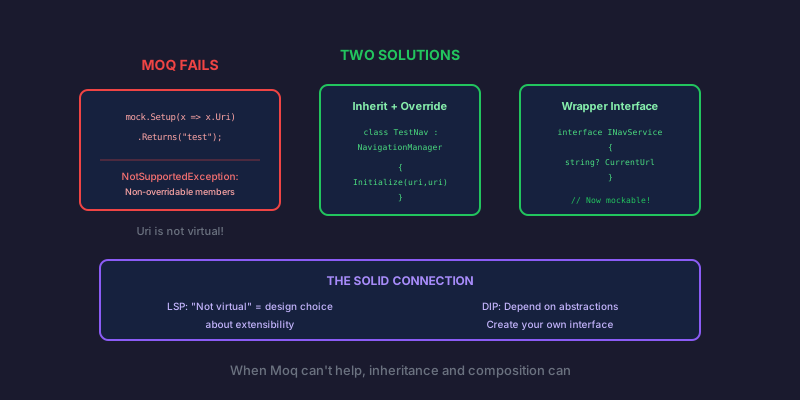
mockNav.Setup(x => x.Uri).Returns("https://example.com/test");
And Moq throws this at you:
System.NotSupportedException: Non-overridable members
(here: NavigationManager.get_Uri) may not be used in
setup / verification expressions.
What's happening? And why does this connect to SOLID principles you learned in school?
Why Moq Can't Mock It
Moq works by creating a dynamic proxy—a subclass of your type that overrides the methods you want to mock. The key word is "overrides."
In C#, you can only override members that are virtual, abstract, or defined in an interface. NavigationManager.Uri is none of these:
public abstract class NavigationManager
{
    // NOT virtual - can't be overridden!
    public string Uri => ...;
}
Microsoft designed it this way because Uri calls internal initialization logic (EnsureInitialized()). Making it virtual would let subclasses bypass that safety check.
The SOLID Connection
This is a real-world example of the Liskov Substitution Principle (LSP) in action.
LSP says: "Objects of a superclass should be replaceable with objects of a subclass without breaking the application."
Microsoft is essentially saying: "We don't trust subclasses to implement Uri correctly, so we're not letting you override it." That's a reasonable design choice for framework code, but it creates testing friction.
It also touches on the Dependency Inversion Principle (DIP): "Depend on abstractions, not concretions."
If NavigationManager were an interface (INavigationManager), you could mock it easily. But it's an abstract class with non-virtual members—a hybrid that's harder to test.
Solution 1: Create Test Implementations
Since you can't override Uri directly, override the methods it calls internally:
/// <summary>
/// Test NavigationManager that simulates an uninitialized state.
/// </summary>
private class UninitializedNavigationManager : NavigationManager
{
    protected override void EnsureInitialized()
    {
        throw new InvalidOperationException(
            "'WebViewNavigationManager' has not been initialized.");
    }
}

/// <summary>
/// Test NavigationManager with a working URL.
/// </summary>
private class TestNavigationManager : NavigationManager
{
    public TestNavigationManager(string uri)
    {
        Initialize(uri, uri);
    }

    protected override void NavigateToCore(string uri, bool forceLoad)
    {
        // Required abstract method - no-op for tests
    }
}
Now you can test both scenarios:
[Fact]
public void WhenNavigationManagerThrows_ReturnsNull()
{
    var navManager = new UninitializedNavigationManager();
    var service = new LoggingService(navManager);

    var result = service.GetCurrentUrlSafely();

    Assert.Null(result);
}

[Fact]
public void WhenNavigationManagerWorks_ReturnsUrl()
{
    var navManager = new TestNavigationManager("https://example.com/page");
    var service = new LoggingService(navManager);

    var result = service.GetCurrentUrlSafely();

    Assert.Equal("https://example.com/page", result);
}
Solution 2: Wrap It (Composition over Inheritance)
If you control the code that uses NavigationManager, you can apply DIP yourself by introducing an abstraction:
public interface INavigationService
{
    string? CurrentUrl { get; }
    void NavigateTo(string url);
}

public class BlazorNavigationService : INavigationService
{
    private readonly NavigationManager _navigationManager;

    public BlazorNavigationService(NavigationManager navigationManager)
    {
        _navigationManager = navigationManager;
    }

    public string? CurrentUrl
    {
        get
        {
            try { return _navigationManager.Uri; }
            catch { return null; }
        }
    }

    public void NavigateTo(string url)
    {
        _navigationManager.NavigateTo(url);
    }
}
Now your code depends on INavigationService, which is trivially mockable:
var mockNav = new Mock<INavigationService>();
mockNav.Setup(x => x.CurrentUrl).Returns("https://example.com/test");
When to Use Which Approach
| Approach | Best For |
|---|---|
| Test implementations | Testing framework behavior, testing failure modes |
| Wrapper interface | Isolating your code from framework details |
The test implementation approach is great when you need to verify how your code handles specific framework behaviors—like "what happens when NavigationManager throws?"
The wrapper approach is better for general isolation—your code doesn't even know NavigationManager exists.
The Bigger Lesson
This situation teaches several important concepts:
- Virtual isn't just syntax — It's a design decision about extensibility
- Framework constraints affect testability — Sometimes you have to work around them
- SOLID principles have real costs — Microsoft chose safety over testability
- Composition and inheritance are both tools — Use the right one for the job
The next time Moq fails on a non-virtual member, don't just be frustrated. Ask why it's not virtual, and choose your workaround accordingly.
Quick Reference
// Won't work - Uri is not virtual
var mock = new Mock<NavigationManager>();
mock.Setup(x => x.Uri).Returns("test");  // THROWS!

// Works - inherit and use protected methods
class TestNav : NavigationManager
{
    public TestNav(string uri) => Initialize(uri, uri);
    protected override void NavigateToCore(string uri, bool forceLoad) { }
}

// Works - wrap in your own interface
interface INavService { string? CurrentUrl { get; } }
var mock = new Mock<INavService>();
mock.Setup(x => x.CurrentUrl).Returns("test");  // SUCCESS!
This pattern came up while testing error handling in a .NET MAUI app. The NavigationManager wasn't mockable, but test implementations let us verify behavior without changing production code.
Related Posts
- MAUI Blazor's NavigationManager Not Initialized Gotcha — The timing bug that made this testing pattern essential
- Error Boundaries That Don't Trap Users — The error boundary code we needed to test