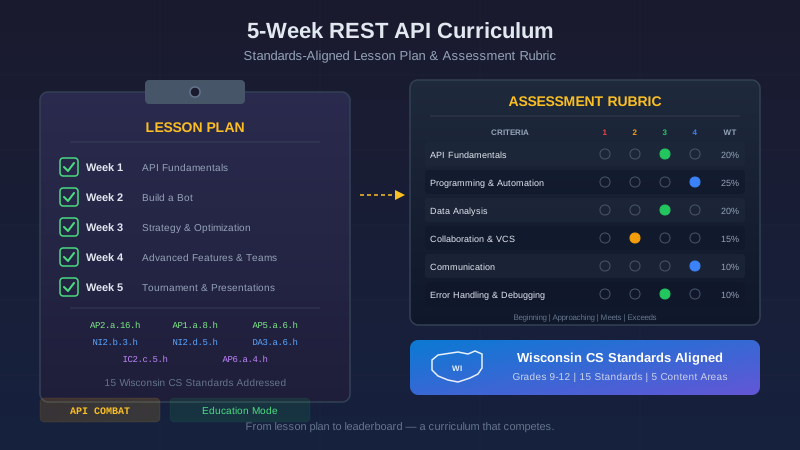
You just read Teaching REST APIs Through Gaming and thought, "That sounds great, but how do I actually use this in my classroom?"
Here's the answer: a complete, standards-aligned lesson plan with an assessment rubric you can hand to your department chair today.
Course Overview
| Course | Introduction to REST APIs Through Competitive Programming |
| Grade Level | 9–12 / Post-secondary |
| Duration | 5 weeks (25 instructional hours) |
| Prerequisites | Basic programming concepts (variables, loops, conditionals) |
| Language | Any (Python recommended for beginners) |
| Tools Required | Text editor, terminal/command line, internet access |
| Platform | API Combat — Education Mode (free for accredited institutions) |
Wisconsin Standards for Computer Science Alignment
This curriculum maps directly to the Wisconsin Standards for Computer Science at the 9–12 grade band. Standards marked with (+) represent advanced expectations for students pursuing computing careers or postsecondary study.
Algorithms & Programming
| Standard | Description | Weeks |
|---|---|---|
| AP1.a.8.h | Analyze a problem and design and implement an algorithmic solution using sequence, selection, and iteration | 2–5 |
| AP1.a.14.h (+) | Develop and use a series of test cases to verify that a program performs according to its design specifications | 3–4 |
| AP2.a.13.h (+) | Decompose a computational problem by creating new data types, functions, or classes | 3–5 |
| AP2.a.16.h (+) | Demonstrate code reuse by creating programming solutions using libraries and application program interfaces (APIs) | 2–5 |
| AP3.c.5.h (+) | Use application programming interface (API) documentation resources | 1–5 |
| AP3.c.6.h | Use online resources to answer technical questions | 1–5 |
| AP4.a.6.h | Deconstruct a complex problem into simpler parts using predefined constructs (e.g., functions and parameters) | 2–4 |
| AP5.a.6.h | Design and develop a software artifact working in a team | 4–5 |
| AP5.a.9.h (+) | Use version control systems, integrated development environments (IDEs), and collaboration tools and practices in a group software project | 4–5 |
| AP6.a.4.h | Use a systematic approach and debugging tools to independently debug a program | 2–5 |
Networks & the Internet
| Standard | Description | Weeks |
|---|---|---|
| NI2.b.3.h | Describe key protocols and underlying processes of internet-based services (e.g., HTTP/HTTPS, SMTP/IMAP, routing protocols) | 1–2 |
| NI2.d.5.h (+) | Explore security policies by implementing and comparing encryption and authentication strategies (e.g., secure coding, safeguarding keys) | 1–3 |
Data & Analysis
| Standard | Description | Weeks |
|---|---|---|
| DA2.a.4.h | Discuss techniques used to store, process, and retrieve different amounts of information (e.g., files, databases, data warehouses) | 3–4 |
| DA3.a.6.h | Use computational tools to collect, transform, and organize data about a problem to explain to others | 3–5 |
Impacts of Computing
| Standard | Description | Weeks |
|---|---|---|
| IC2.c.5.h | Ethically and safely select, observe, and contribute to global collaboration in the development of a computational artifact | 4–5 |
Week-by-Week Lesson Plans
Week 1: API Fundamentals — Manual API Calls
Learning Objectives:
- Explain what a REST API is and why it matters in modern software
- Construct HTTP requests using curl or Postman
- Authenticate with a remote service using Bearer tokens
- Parse JSON responses and identify data structures
Activities:
| Day | Activity | Details |
|---|---|---|
| 1–2 | Introduction to HTTP and REST | Instructor-led demo: making API calls with curl. Students register an API Combat account via the API itself — their first POST request. |
| 3 | JSON Deep-Dive | Students examine API responses. Identify objects, arrays, nested fields. Map JSON structure to real-world concepts (roster = array of unit objects). |
| 4–5 | First Battle | Students authenticate, retrieve their roster (GET /api/v1/player/roster), and queue their first battle. Journal entry: document every request/response pair with annotations. |
Deliverable: Annotated log of a completed battle showing request method, endpoint, headers, payload, and response for each API call made.
Standards Addressed: AP3.c.5.h, AP3.c.6.h, NI2.b.3.h, NI2.d.5.h
Week 2: Automation — Build a Bot
Learning Objectives:
- Write a script that makes HTTP requests programmatically
- Implement loops and conditionals for iterative API interaction
- Handle error responses from a remote API
- Log structured results to a file for later analysis
Activities:
| Day | Activity | Details |
|---|---|---|
| 1 | From curl to code | Introduction to the requests library (Python) or equivalent. Students convert their manual curl commands into a script. |
| 2–3 | Build the bot | Write a bot that auto-queues 10 battles and logs results: wins, losses, error codes, timestamps. |
| 4–5 | Error handling workshop | Introduce HTTP status codes (400, 401, 403, 429, 500). Students add retry logic for rate limits (429 Too Many Requests). Discuss exponential backoff. |
Deliverable: Working bot script that completes 10 battles autonomously with error handling and a structured log file of results.
Standards Addressed: AP1.a.8.h, AP2.a.16.h, AP4.a.6.h, AP6.a.4.h, NI2.d.5.h
Week 3: Strategy & Optimization
Learning Objectives:
- Create and upload strategy configurations via the API
- Design controlled experiments to compare approaches
- Apply basic data analysis to optimize outcomes
- Interpret rate-limiting headers and implement request throttling
Activities:
| Day | Activity | Details |
|---|---|---|
| 1–2 | Strategy deep-dive | Students study the strategy JSON schema. Create and upload 3 distinct formations using POST /api/v1/strategies/upload. |
| 3 | A/B testing workshop | Run each strategy through 20+ battles. Record win rates per strategy. Discuss what constitutes a meaningful sample size. |
| 4–5 | Data analysis | Calculate win rates, compare formations, identify patterns. Written analysis: which strategy performs best and why? Support conclusions with data. |
Deliverable: Three strategy JSON configurations, raw battle results data, and a written analysis (500–800 words) with win-rate calculations and evidence-based conclusions.
Standards Addressed: AP1.a.8.h, AP1.a.14.h, AP2.a.13.h, DA2.a.4.h, DA3.a.6.h
Week 4: Advanced Features & Collaboration
Learning Objectives:
- Use batch operations and simulation endpoints for large-scale data collection
- Aggregate and analyze datasets with 100+ data points
- Collaborate with teammates using version control
- Contribute to a shared software project using professional tools
Activities:
| Day | Activity | Details |
|---|---|---|
| 1–2 | Simulation endpoint | Introduction to batch operations. Students run 100+ simulated battles and collect structured data. |
| 3 | Statistical analysis workshop | Calculate mean, median, and standard deviation of battle outcomes. Create visualizations (charts, tables). |
| 4–5 | Team formation (Guilds) | Form teams of 3–4 students. Set up a shared GitHub repository. Share strategies, coordinate guild war tactics, conduct peer code review. |
Deliverable: Simulation report with data visualizations (minimum 100 battles analyzed), plus a team GitHub repository with shared strategies and documented commit history.
Standards Addressed: AP2.a.13.h, AP5.a.6.h, AP5.a.9.h, DA3.a.6.h, IC2.c.5.h
Week 5: Tournament & Presentation
Learning Objectives:
- Optimize a fully autonomous bot for competitive performance
- Present technical findings and decisions to peers
- Evaluate and reflect on the iterative development process
- Demonstrate collaborative software development practices
Activities:
| Day | Activity | Details |
|---|---|---|
| 1–2 | Final optimization | Teams refine strategies, improve error handling, add advanced features. Final bot must run fully autonomously. |
| 3 | Class tournament | Bots compete on the live leaderboard. Real-time results projected for the class. |
| 4–5 | Presentations & reflection | Each team presents their approach (5–10 minutes): architecture decisions, what worked, what failed, what they'd do differently. Peer feedback. Individual reflection essay. |
Deliverable: Tournament-ready autonomous bot, team presentation (5–10 minutes with slides or live demo), and an individual reflection essay (300–500 words).
Standards Addressed: AP1.a.14.h, AP5.a.6.h, AP5.a.9.h, DA3.a.6.h, IC2.c.5.h
Assessment Rubric
Performance Levels
| Level | Score | Description |
|---|---|---|
| Exceeds Expectations | 4 | Demonstrates mastery beyond requirements. Independently extends concepts and applies them in novel ways. |
| Meets Expectations | 3 | Demonstrates solid understanding. Meets all requirements with only minor gaps. |
| Approaching Expectations | 2 | Demonstrates partial understanding. Meets some requirements, often with instructor support. |
| Beginning | 1 | Demonstrates limited understanding. Significant gaps in meeting requirements. |
Scoring Criteria
1. API Fundamentals & HTTP Protocol — 20%
Standards: NI2.b.3.h, NI2.d.5.h, AP3.c.5.h
| Exceeds (4) | Meets (3) | Approaching (2) | Beginning (1) |
|---|---|---|---|
| Correctly constructs all HTTP method types (GET, POST, PUT, DELETE). Explains REST constraints and authentication flows unprompted. Independently troubleshoots auth issues and token expiration. | Correctly uses GET, POST, PUT, DELETE with appropriate payloads. Authenticates using Bearer tokens. Explains the purpose of each HTTP method. | Uses 2–3 HTTP methods correctly. Authenticates with instructor support. Partially explains method purposes. | Struggles to construct HTTP requests. Cannot authenticate independently. Limited understanding of the request/response cycle. |
2. Programming & Automation — 25%
Standards: AP1.a.8.h, AP2.a.16.h, AP4.a.6.h
| Exceeds (4) | Meets (3) | Approaching (2) | Beginning (1) |
|---|---|---|---|
| Bot runs fully autonomously with robust error handling, exponential backoff, and structured logging. Code is well-organized with functions or classes and handles edge cases gracefully. | Bot completes 10+ battles automatically. Includes basic error handling and file logging. Code uses functions and loop constructs appropriately. | Bot runs but requires some manual intervention. Some error handling present. Code works but lacks clear structure or organization. | Bot does not run reliably. Minimal or no error handling. Code is incomplete or non-functional without significant assistance. |
3. Data Analysis & Optimization — 20%
Standards: DA2.a.4.h, DA3.a.6.h, AP1.a.14.h
| Exceeds (4) | Meets (3) | Approaching (2) | Beginning (1) |
|---|---|---|---|
| Analyzes 100+ simulations using statistical methods (mean, median, standard deviation). Creates clear data visualizations. Draws evidence-based conclusions with specific, actionable recommendations. | Runs 20+ battles per strategy. Calculates win rates accurately. Identifies best-performing strategy with supporting data and a written explanation. | Compares 2 strategies with limited data (<20 battles). Identifies a preference but lacks quantitative support for conclusions. | Does not collect meaningful data. No comparison between strategies. Conclusions are absent or entirely unsupported by evidence. |
4. Collaboration & Version Control — 15%
Standards: AP5.a.6.h, AP5.a.9.h, IC2.c.5.h
| Exceeds (4) | Meets (3) | Approaching (2) | Beginning (1) |
|---|---|---|---|
| Active contributor with meaningful, well-documented commits. Reviews teammates' code constructively. Manages merge conflicts. Demonstrates leadership in guild coordination and strategy. | Commits code regularly to shared repository. Collaborates effectively on team tasks. Participates in guild activities and peer review. | Limited commits to shared repository. Some participation in team activities. Requires prompting to collaborate or share work. | Does not use version control meaningfully. Minimal team participation. Does not contribute to shared artifacts or guild coordination. |
5. Communication & Presentation — 10%
Standards: AP5.a.6.h
| Exceeds (4) | Meets (3) | Approaching (2) | Beginning (1) |
|---|---|---|---|
| Presentation is clear, well-organized, and technically precise. Explains design trade-offs and demonstrates deep understanding of choices made. Answers audience questions confidently. | Presents findings clearly with logical organization. Explains approach and results. Responds to basic questions from peers and instructor. | Presentation covers required topics but lacks depth or clear organization. Difficulty answering follow-up questions. | Presentation is incomplete or unclear. Cannot explain approach, results, or technical decisions made during the project. |
6. Error Handling & Debugging — 10%
Standards: AP6.a.4.h, NI2.d.5.h
| Exceeds (4) | Meets (3) | Approaching (2) | Beginning (1) |
|---|---|---|---|
| Implements comprehensive error handling for all common HTTP status codes. Uses a systematic debugging approach (read error, form hypothesis, test fix). Documents error resolution process in code comments or log. | Handles common errors (400, 401, 429). Debugs most API issues independently. Implements basic retry logic for rate limits. | Handles 1–2 error types. Requires some instructor support for debugging unfamiliar errors. | No meaningful error handling. Cannot debug API errors without significant step-by-step assistance. |
Grading Scale
| Weighted Score | Grade |
|---|---|
| 3.5 – 4.0 | A |
| 3.0 – 3.49 | B |
| 2.5 – 2.99 | C |
| 2.0 – 2.49 | D |
| Below 2.0 | F |
Each criterion is scored 1–4, then multiplied by its weight. Final score is the sum of all weighted scores. Example: A student scoring 4 in Programming (25%) contributes 1.0 to the total.
Materials & Resources
Required (Free):
- API Combat account (free tier) — apicombat.com
- Text editor (VS Code recommended)
- Terminal access (Command Prompt, PowerShell, or Bash)
- Python 3.x with
requestslibrary (or equivalent in student's preferred language)
Provided with Education Mode (Free for Accredited Institutions):
- Class-scoped tournaments and leaderboards
- Instructor dashboard with lesson completion rates and student enrollment progress
- Instructor-defined curriculum modules with endpoint-linked lessons
- Guild Wars team battle functionality
Optional:
- GitHub accounts for version control activities (Weeks 4–5)
- Postman for visual API exploration (Week 1)
- Jupyter Notebooks for data analysis and visualization (Weeks 3–4)
Differentiation
For advanced students:
- Implement webhook notifications for battle results
- Build a web dashboard that displays battle statistics and win-rate trends
- Analyze opponent strategies and build adaptive counter-strategies
- Extend the bot with command-line arguments for configurable behavior
For students needing additional support:
- Provide starter code templates with comments indicating where to add logic
- Pair programming during automation activities (Weeks 2–3)
- Reduce battle count requirements while maintaining all concept areas
- Offer structured debugging checklists for common API errors
What This Lesson Plan Doesn't Include
This document gives you everything you need for a compelling five-week unit. But the full Education Mode experience includes tools that a lesson plan can't capture:
- Progress dashboards — Track student lesson completions, enrollment status, and per-lesson completion rates
- Tournament infrastructure — Bracket generation, leaderboards, and match scheduling for class-wide events
- Curriculum modules — Instructor-defined lesson sequences with endpoint-linked verification steps
- Guild Wars — Team-based competitive battles that encourage collaboration and code sharing
These are the tools that turn a good lesson plan into a curriculum ecosystem.
Get Started This Semester
This lesson plan is yours to use — no strings attached. If you want the platform and tools behind it:
- Request Education Mode access at learnedgeek.com/Contact
- Include your institution name, course title, class size, and semester dates
- I'll get your class set up and walk you through the educator tools
Education Mode is free for accredited institutions. K–12, universities, bootcamps — if you're teaching, you're in.
I built API Combat because students deserve better than todo-list APIs. If this lesson plan resonates, let's talk about what a full semester looks like.
This lesson plan accompanies Teaching REST APIs Through Gaming: Why API Combat Works in the Classroom. For the student-facing tutorial, see Your First Battle: A Complete Walkthrough.
Co-Authored-By: Claude Opus 4.6 [email protected]