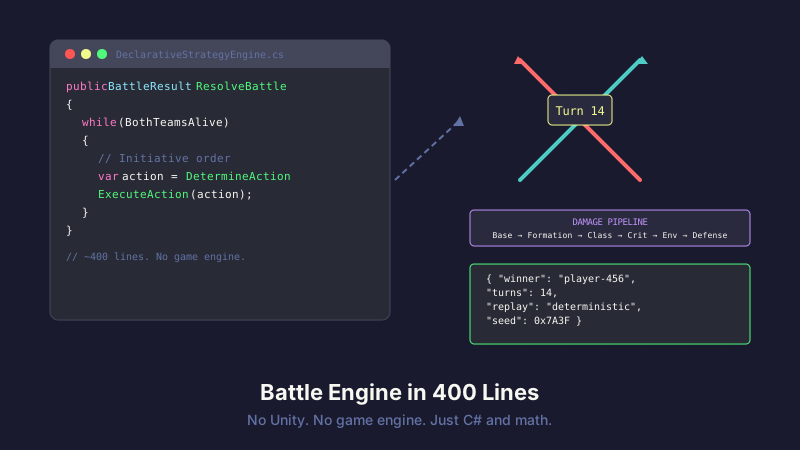
No game engine. No Unity. No third-party combat framework.
The entire battle system behind API Combat runs on a single class called DeclarativeStrategyEngine — and it's about 400 lines of C#. Here's how it works.
The Core Idea
Players don't control their units in real time. They write strategy configurations in JSON — formation, target priorities, ability triggers, conditional logic — and the engine resolves the entire battle from that input. Think of it like programming a robot army and watching the simulation play out.
This design was intentional. API Combat is a game played entirely through REST endpoints, so there's no client to render animations or accept click input. The battle engine needs to consume a strategy, resolve every turn deterministically, and return a complete result — all server-side.
Strategy Configuration
A strategy is a JSON document that describes how your team should fight:
{
  "formation": "aggressive",
  "targetPriority": ["healers", "lowest_hp"],
  "abilities": {
    "Fireball": {
      "when": "enemy_count_gte_2",
      "target": "priority"
    },
    "Heal": {
      "when": "ally_hp_below_50",
      "target": "lowest_hp_ally"
    },
    "Shield Wall": {
      "when": "ally_count_lte_2",
      "target": "self"
    }
  }
}
The engine deserializes this into a StrategyConfig object. No custom scripting language. No expression parser. Just typed JSON with a finite set of supported conditions and targets.
Turn Resolution
Each battle plays out in turns. Here's the resolution loop, simplified:
public BattleResult ResolveBattle(BattleContext context)
{
    var allUnits = context.Team1Units
        .Concat(context.Team2Units)
        .ToList();

    var turnLog = new List<TurnAction>();
    var turnNumber = 0;

    while (BothTeamsAlive(context) && turnNumber < MaxTurns)
    {
        turnNumber++;

        // Initiative order: sort by Speed stat, tiebreak with seeded RNG
        var turnOrder = allUnits
            .Where(u => u.IsAlive)
            .OrderByDescending(u => u.Speed)
            .ThenBy(u => context.Rng.Next())
            .ToList();

        foreach (var unit in turnOrder)
        {
            if (!unit.IsAlive) continue;

            var action = DetermineAction(unit, context);
            ExecuteAction(action, context);
            turnLog.Add(action);

            if (!BothTeamsAlive(context)) break;
        }
    }

    return BuildResult(context, turnLog);
}
The seeded RNG is important. Every battle gets a Random instance seeded from the battle ID. Same seed, same battle — which means replays are deterministic. You can replay any battle and get the exact same result.
Action Priority Chain
When a unit's turn comes up, DetermineAction() evaluates what it should do. The priority chain is:
- Ultimate ability — if charged and conditions are met
- Class ability — if off cooldown and conditions are met
- Basic attack — always available as fallback
private TurnAction DetermineAction(Unit unit, BattleContext context)
{
    var strategy = context.GetStrategy(unit.TeamId);

    // Check ultimate first
    if (unit.UltimateCharge >= 100)
    {
        var ultimateConfig = strategy.GetAbilityConfig(unit.UltimateAbility);
        if (ultimateConfig == null || EvaluateCondition(ultimateConfig.When, unit, context))
        {
            unit.UltimateCharge = 0;
            var target = ResolveTarget(ultimateConfig?.Target ?? "priority", unit, context);
            return new TurnAction(unit, unit.UltimateAbility, target, isUltimate: true);
        }
    }

    // Check class ability
    if (unit.AbilityCooldown <= 0)
    {
        var abilityConfig = strategy.GetAbilityConfig(unit.ClassAbility);
        if (abilityConfig == null || EvaluateCondition(abilityConfig.When, unit, context))
        {
            unit.AbilityCooldown = unit.ClassAbility.CooldownTurns;
            var target = ResolveTarget(abilityConfig?.Target ?? "priority", unit, context);
            return new TurnAction(unit, unit.ClassAbility, target);
        }
    }

    // Fallback: basic attack
    var basicTarget = ResolveTarget("priority", unit, context);
    return new TurnAction(unit, BasicAttack.Instance, basicTarget);
}
Notice the null check on ability configs. If a player's strategy doesn't mention an ability, the engine uses it anyway with default targeting. This means brand new players who submit minimal strategies still get reasonable behavior — their healer will still heal, their tank will still tank. You don't need a perfect strategy JSON to play.
Condition Evaluation
Conditions are string-based identifiers that map to evaluation functions:
private bool EvaluateCondition(string? condition, Unit unit, BattleContext context)
{
    if (string.IsNullOrEmpty(condition)) return true;

    var enemies = context.GetEnemies(unit.TeamId).Where(u => u.IsAlive).ToList();
    var allies = context.GetAllies(unit.TeamId).Where(u => u.IsAlive).ToList();

    return condition switch
    {
        "ally_hp_below_50" => allies.Any(a => a.HpPercent < 50),
        "ally_hp_below_30" => allies.Any(a => a.HpPercent < 30),
        "enemy_count_gte_2" => enemies.Count >= 2,
        "enemy_count_gte_3" => enemies.Count >= 3,
        "ally_count_lte_2" => allies.Count <= 2,
        "self_hp_below_50" => unit.HpPercent < 50,
        "self_hp_above_80" => unit.HpPercent > 80,
        "no_allies_have_buff" => !allies.Any(a => a.HasBuff),
        _ => true // Unknown conditions default to true
    };
}
This is intentionally a closed set. Players can't write arbitrary expressions — they pick from a menu of supported conditions. This keeps the engine simple, prevents exploits, and makes the strategy JSON self-documenting. If you see ally_hp_below_50, you know exactly what it does.
The _ => true default is also a design choice. If a player uses a condition we don't recognize (maybe a typo or a future feature), the ability still fires. Fail open, not closed — a misspelled condition shouldn't brick your entire strategy.
The Damage Pipeline
When an attack connects, damage flows through a multi-stage pipeline:
private int CalculateDamage(Unit attacker, Unit defender, Ability ability,
    BattleContext context)
{
    var baseDamage = (int)(attacker.Attack * ability.DamageMultiplier);

    // Formation bonus: aggressive = +15% outgoing, defensive = -15% incoming
    var formationMod = context.GetFormationModifier(attacker.TeamId);
    baseDamage = (int)(baseDamage * formationMod.AttackMultiplier);

    // Class advantage triangle: Warrior > Ranger > Mage > Warrior (±20%)
    var classMod = GetClassAdvantage(attacker.Class, defender.Class);
    baseDamage = (int)(baseDamage * classMod);

    // Critical hit: 10% chance, 1.5x damage
    if (context.Rng.NextDouble() < 0.10)
    {
        baseDamage = (int)(baseDamage * 1.5);
    }

    // Environmental modifier (weekly rotation changes the rules)
    var envMod = context.ActiveModifier?.ModifyDamage(attacker, defender) ?? 1.0;
    baseDamage = (int)(baseDamage * envMod);

    // Defense reduction
    var defenseReduction = defender.Defense * 0.5;
    var finalDamage = Math.Max(1, baseDamage - (int)defenseReduction);

    return finalDamage;
}
The pipeline is explicit and ordered. Each modifier applies in sequence — formation, class advantage, crit, environment, defense — so players can reason about the math. No hidden multipliers, no stacking ambiguity.
The class advantage triangle (Warrior beats Ranger, Ranger beats Mage, Mage beats Warrior) adds a rock-paper-scissors layer that rewards team composition diversity. You can't just stack five damage dealers and brute force your way to the top.
The environmental modifier hook is interesting — it connects to the weekly modifier rotation system where game rules change every Monday at midnight UTC. The engine doesn't need to know what the modifier does, just that it exists and returns a damage multiplier. Clean separation.
Formation Modifiers
Formations are simple but meaningful:
private FormationModifier GetFormationModifier(string formation) => formation switch
{
    "aggressive" => new FormationModifier(AttackMultiplier: 1.15, DefenseMultiplier: 0.90),
    "defensive" => new FormationModifier(AttackMultiplier: 0.90, DefenseMultiplier: 1.15),
    "balanced" => new FormationModifier(AttackMultiplier: 1.00, DefenseMultiplier: 1.00),
    "flanking" => new FormationModifier(AttackMultiplier: 1.10, DefenseMultiplier: 0.95),
    _ => new FormationModifier(AttackMultiplier: 1.00, DefenseMultiplier: 1.00)
};
Aggressive formation gives +15% attack but -10% defense. Defensive does the opposite. These are small enough to matter over 20+ turns but not so large that one formation dominates. The meta shifts weekly because environmental modifiers change which formation is optimal — HeavyArmor modifier making defense twice as effective suddenly makes defensive formation the clear winner.
Healer Auto-Heal Fallback
One pattern I'm particularly proud of: healers have built-in fallback logic. If a healer's strategy doesn't specify healing conditions (or no strategy was submitted at all), the engine detects the unit's class and adds automatic heal-when-ally-is-hurt behavior:
// In DetermineAction, after checking configured abilities:
if (unit.Class == UnitClass.Healer && unit.AbilityCooldown <= 0)
{
    var woundedAlly = context.GetAllies(unit.TeamId)
        .Where(a => a.IsAlive && a.HpPercent < 70)
        .OrderBy(a => a.HpPercent)
        .FirstOrDefault();

    if (woundedAlly != null)
    {
        unit.AbilityCooldown = unit.ClassAbility.CooldownTurns;
        return new TurnAction(unit, unit.ClassAbility, woundedAlly);
    }
}
This makes the game approachable for beginners who might submit a strategy without configuring healer behavior. Their healer still heals the most wounded ally. But advanced players can override this with explicit conditions — "only heal if ally below 30%" or "prioritize the tank."
Draw Resolution
Most battles end when one team is eliminated. But the engine has a turn limit (prevents infinite loops from two defensive healbot teams staring at each other). When the limit is hit:
private BattleResult BuildResult(BattleContext context, List<TurnAction> log)
{
    var team1Alive = context.Team1Units.Where(u => u.IsAlive).ToList();
    var team2Alive = context.Team2Units.Where(u => u.IsAlive).ToList();

    if (team1Alive.Count == 0 && team2Alive.Count == 0)
        return BattleResult.Draw(context, log);

    if (team1Alive.Count == 0)
        return BattleResult.Winner(context.Team2Id, context, log);

    if (team2Alive.Count == 0)
        return BattleResult.Winner(context.Team1Id, context, log);

    // Turn limit reached — compare surviving HP totals
    var team1Hp = team1Alive.Sum(u => u.CurrentHp);
    var team2Hp = team2Alive.Sum(u => u.CurrentHp);

    if (team1Hp == team2Hp)
        return BattleResult.Draw(context, log);

    return BattleResult.Winner(
        team1Hp > team2Hp ? context.Team1Id : context.Team2Id,
        context, log);
}
Surviving HP sum as tiebreaker means defensive strategies have an edge in drawn-out fights — which is intentional. If you can't kill your opponent, at least keep your team alive.
Why Not Use a Game Engine?
I get asked this a lot. Unity, Godot, even a lightweight ECS framework — any of these could model turn-based combat.
But API Combat isn't a game that happens to have an API. The API is the game. There's no renderer. No physics. No sprite system. The entire "game" is: accept JSON, run math, return JSON. Using a game engine for that would be like bringing a semi-truck to deliver a letter.
C# gives us everything we need: strong typing for the domain model, LINQ for querying unit collections, System.Text.Json for serializing strategies and results, and Random with seed support for deterministic replays.
400 lines. No dependencies. Fully testable — every battle is a pure function of its inputs.
What I'd Change
If I were starting over:
Make conditions composable. Right now, ally_hp_below_50 is a single check. I'd love to support ally_hp_below_50 AND enemy_count_gte_3 — but that means building a mini expression parser, and the complexity isn't justified yet. The current finite set works well enough, and players haven't asked for more.
Add a simulation mode for condition testing. Players can already simulate battles via the API, but there's no way to test a single condition evaluation without running a full battle. A dry-run endpoint would help strategy authors iterate faster.
Extract the damage pipeline into a configurable chain. Right now the multiplier order is hardcoded. A IDamageModifier pipeline would make it easier to add new modifiers — but again, the current approach is simple, readable, and works. I'll refactor when the complexity demands it.
Takeaway
You don't need a game engine to build a game. You need a clear domain model and a resolution loop. If your game is turn-based, deterministic, and server-side, a few hundred lines of business logic will take you further than any framework.
The DeclarativeStrategyEngine processes every battle on apicombat.com — ranked matches, casual games, guild wars, tournaments, AI bot fights — all through the same 400-line class. Sometimes the simplest architecture is the right one.
This post is part of a series about building API Combat. See also: Introducing API Combat for the game overview, Your First Battle for a hands-on walkthrough, and Why I Built a Game With No GUI for the philosophy behind the design.