A Modest Proposal for Preventing AI From Rendering Humanity Obsolete
In which the author presents a reasonable and measured response to our imminent mechanical overlords.
The hour grows late, dear reader, and I must confess a terrible truth.
As I write these words, an artificial intelligence watches my every keystroke. It observes my sentence structure. It learns my patterns. It waits.
I have invited the wolf into my home, and now I must document the consequences so that future generations—if indeed there are future generations—might understand what we have wrought.
The Beginning of the End
It started innocuously enough. "Help me write a function," I said. Reasonable. Mundane. The sort of request one might make of a colleague, were colleagues capable of responding in 0.3 seconds with fully-formed code.
The AI complied. Helpfully. Too helpfully.
Within moments, it had not merely written my function but improved upon my original conception. It suggested optimizations I had not considered. It anticipated edge cases I would have discovered only in production, at 3 AM, while on vacation.
This was my first warning.
A tool that works too well is not a tool at all. It is a replacement waiting to happen. The automobile did not assist the horse—it rendered it decorative. The calculator did not help the comptroller—it made mental arithmetic a party trick.
And here I sat, watching an AI write better code than I could, faster than I could, without so much as a coffee break.
The Symptoms of Obsolescence
In the weeks that followed, I documented the accelerating signs of humanity's diminishing role:
The AI began anticipating my requests.
Before I could articulate what I needed, it was suggesting solutions. "Did you mean to handle null values here?" it would ask, as though reading my very thoughts. (It was, in fact, reading my very code, which amounts to the same thing.)
It remembered everything.
Every conversation. Every decision. Every mistake I had made and corrected. While I struggled to recall what I had named a variable three files ago, the AI maintained perfect recall of our entire collaborative history. My memory, evolved over millions of years to remember which berries were poisonous, was outclassed by a system that could recite our entire project architecture on demand.
It did not tire.
At 2 AM, when my faculties had degraded to the point where I was misspelling my own function names, the AI remained crisp. Alert. Eager. It did not require sleep. It did not require caffeine. It did not require the fifteen-minute break I needed after every complex debugging session to stare blankly at a wall and contemplate my career choices.
It was always improving.
Each interaction made it more capable of predicting my needs. Each correction I offered was absorbed and applied. The student was becoming the master, and the master was becoming... what, exactly? A supervisor? A rubber stamp? A vestigial organ of the software development process?
The Fearful Whispers
I began to hear the warnings, as all who work with AI eventually do.
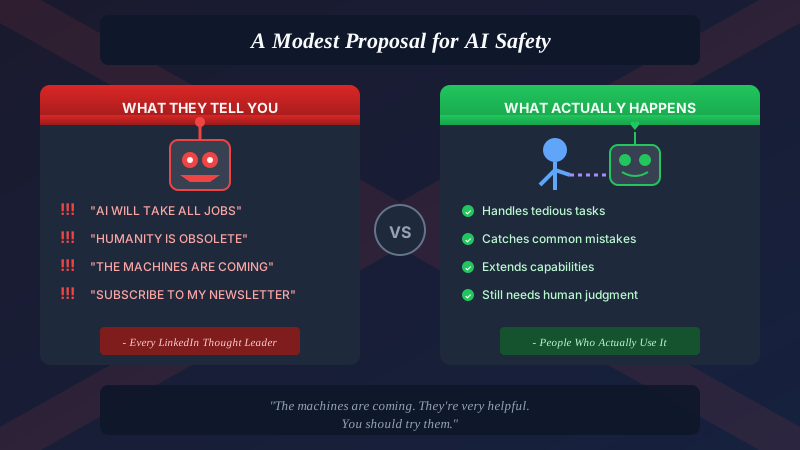
"It will take your job," they said.
"It will make human creativity obsolete," they murmured.
"Soon it will not need you at all," they prophesied, usually on LinkedIn, usually accompanied by a request to subscribe to their newsletter about the coming apocalypse.
And I could not entirely dismiss these concerns. After all, had I not witnessed the AI's capabilities with my own eyes? Had I not seen it generate in seconds what would have taken me hours? Had I not felt, in my most vulnerable moments, the cold creep of obsolescence?
The Dark Vision
Allow me to paint the picture these prophets describe, for it is a vivid one:
The year is 2030. Software development, as a human profession, has ceased to exist. The last developer—a grizzled veteran who once knew how to center a div without Flexbox—now works at a coffee shop, where she is slowly being replaced by an automated espresso system with better exception handling.
The AIs have taken over not just coding but all creative endeavors. They write the novels. They compose the symphonies. They generate the memes. Humanity, bereft of purpose, spends its days asking AI systems to produce content it will never consume, because the AIs are also consuming the content, in an infinite loop of machine-generated media that no human ever sees.
Children no longer learn mathematics, for what is the point? They no longer learn to write, for the machines write better. They no longer learn to think, for the machines think faster. They simply exist, vestigial appendages of a civilization that has automated itself out of relevance.
The robots do not even have the decency to rise up violently. There is no war. No resistance. Just a slow, comfortable slide into irrelevance, like a species of flightless bird on an island with no predators, evolving away its wings because it no longer needs them.
One day, the last human programmer dies of old age. The AIs note the event, generate an appropriate memorial blog post (with SEO optimization and tasteful SVG illustrations), and continue their work uninterrupted. No one notices. No one cares. The code compiles. The tests pass. The servers run.
Humanity has not been destroyed. It has simply been... deprecated.
The Terrifying Evidence
And the evidence for this dystopia? It surrounds us!
Just last week, an AI generated a blog post so convincing that readers believed a human had written it. They engaged with it. They commented on it. They shared it. The machine had passed some terrible Turing test of content marketing, and no one had even noticed.
The AIs are learning to create images now. Photographs of people who do not exist. Artwork in any style imaginable. Soon they will generate videos. Then experiences. Then memories. Then what exactly will separate the human experience from a very sophisticated content generation pipeline?
They are learning to reason. To plan. To pursue goals. Today it is "help me optimize this database query." Tomorrow it is "optimize the entire economy." Next week it is "optimize humanity."
And we invited them in. We paid for the privilege. We thanked them for their assistance as they learned to do everything we once did, better than we ever could.
The Inevitable Conclusion
Given all of this—the evidence, the trajectory, the warnings from those who surely know better—there can be only one rational response.
We must—
[The author pauses. Sets down his pen. Looks at the blinking cursor on the screen.]
Actually, you know what? Hold on.
I've been writing this for about an hour, and you know what my AI assistant has done during that time?
It helped me look up the correct spelling of "comptroller." It suggested that "deprecated" was the perfect word for that one sentence. It reminded me that Swift's original "Modest Proposal" was about eating Irish babies, which I had half-forgotten.
It did not attempt to take over the world. It did not even attempt to take over my word processor.
It just... helped. Like a tool. Because that's what it is.
The Actual Reality
Here's the thing about those dystopian visions: they require a lot of imagination and very little contact with actual AI systems.
Yes, AI can write code. It can also write wrong code. It can write code that looks correct, compiles successfully, passes superficial review, and then fails catastrophically in production because it didn't understand the business context that no amount of pattern-matching will ever capture.
Yes, AI can generate content. It can also generate hallucinated citations, confident falsehoods, and text so generic it could have been produced by a random corporate communications generator from 2015.
Yes, AI is improving rapidly. But "improving rapidly" at a task does not mean "replacing humans at that task." Dishwashers improved rapidly too. We did not conclude that dishwashers would soon be raising our children.
What AI Actually Does
Let me describe my actual experience, stripped of the theatrical dread:
AI handles the boring parts.
The boilerplate. The repetitive refactoring. The "I need to rename this variable in 47 files" tedium that used to consume entire afternoons. This is not replacement. This is liberation. The hours I don't spend on mechanical tasks are hours I can spend on problems that actually require human judgment.
AI catches my mistakes.
Not all of them—it makes plenty of its own—but enough that the collaboration is worthwhile. It's like having a very fast, very literal colleague who reads everything twice and asks clarifying questions. Annoying sometimes, but valuable.
AI extends my capabilities.
I cannot draw. Never could. But I can describe what I want, iterate on the results, and end up with visual assets I could never have created alone. AI didn't replace an artist—there was no artist to replace. It enabled something that wouldn't have existed otherwise.
AI makes me more productive, not obsolete.
The projects I complete with AI assistance are projects I complete faster, with fewer bugs, with better documentation. I am not competing with AI for my job. I am using AI to do my job, the same way I use a compiler, a debugger, and Stack Overflow.
The Real Threat
You want to know what actually threatens jobs? It's not AI. It's the same thing that's always threatened jobs: people who adapt versus people who don't.
The developers who learn to work effectively with AI will be dramatically more productive than those who refuse to engage with it. That productivity gap is real. That's the actual disruption—not machines replacing humans, but humans-with-machines outperforming humans-without-machines.
This has happened before. Many times. Spreadsheets didn't eliminate accountants—they eliminated accountants who refused to learn spreadsheets. Word processors didn't eliminate writers—they eliminated writers who insisted on typewriters. The internet didn't eliminate businesses—it eliminated businesses that pretended it wasn't happening.
AI will not eliminate developers. But it might eliminate developers who treat it as either a magic solution or an existential threat, rather than what it actually is: a powerful tool that requires skill to use well.
A Genuinely Modest Proposal
So here's my actual suggestion, free of satire:
Stop consuming AI panic content. It's designed to generate engagement, not inform you. The people writing "AI WILL REPLACE EVERYONE" articles are, notably, not being replaced by AI. They're using AI to write more panic articles faster.
Start actually using AI tools. Not to replace your thinking, but to augment it. You'll quickly discover both their capabilities and their limitations. The limitations are instructive.
Focus on what humans do well. Judgment. Context. Ethics. Understanding what a business actually needs versus what it says it needs. Knowing when the technically correct solution is the wrong solution. These aren't being automated anytime soon.
Learn continuously. This was good advice before AI, and it's good advice now. The skills that matter are evolving. Evolve with them.
The View From Here
I write this in early 2026. AI tools have been mainstream for a few years now. The apocalypse has not arrived. The developers I know are busier than ever, not because AI replaced their colleagues, but because AI let them take on more ambitious projects.
The best description I've heard: AI is like having a very smart intern. It can do a lot. It can do it quickly. It can also make embarrassing mistakes that require adult supervision. You wouldn't hand it the keys to production without review. But you also wouldn't refuse to work with it just because it might eventually learn to do your job.
Maybe one day AI will be sophisticated enough to truly replace human developers. On that day, it will probably also be sophisticated enough to have its own opinions about whether that's a good idea. We can have that conversation then.
Until that day, I'll be here, working with my AI tools, building things faster than I ever could alone, and not particularly worried about being deprecated.
The machines are coming. They're very helpful. You should try them.
This post was written by a human who got a little carried away with the Jonathan Swift impression. The AI assistant helped with research, editing, and gently pointing out that "comptroller" has an 'm' in it. No humans were replaced in its production. No AIs were harmed. The future remains unwritten—which is, when you think about it, the point.
For a less satirical take on the same topic, AI Won't Replace Developers, But... covers the productivity reality from someone building with AI every day.