You just survived a deep dive into generative agent memory — Park et al., three-way retrieval scoring, reflection synthesis. Academic stuff.
This is the "explain it to your mom" version.
Your Brain Is a Library
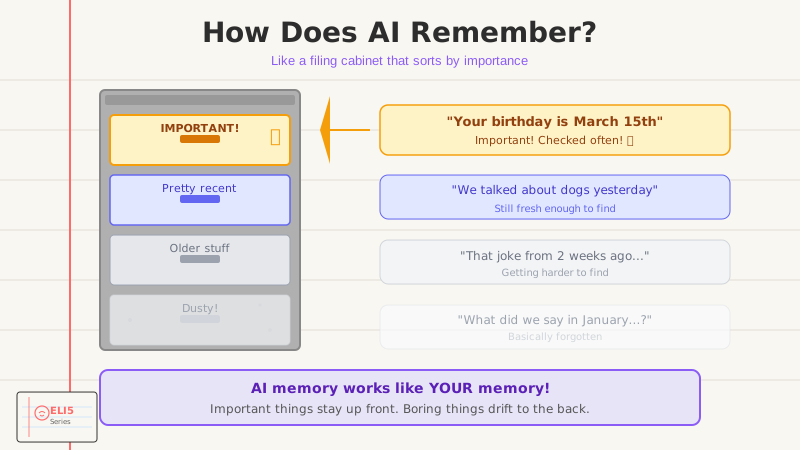
Imagine your brain is a library. Every conversation you have, every event that happens, every feeling you feel — each one becomes a book on a shelf. Over time, you end up with thousands of books.
Now someone asks you a question. "What did we talk about last week?" A librarian in your head goes running through the stacks to find the right book. But with thousands of books, how does the librarian know which one to grab?
The Three-Clue System
ANI's librarian uses three clues to find the right memory:
Clue 1: Is it about the same thing? If you ask about your dog, the librarian looks for books about your dog. Not books about dogs in general. Not books about pets. YOUR dog. This is relevance — how closely does the memory match what you are talking about right now?
Clue 2: Is it important? Some books are on the "Important" shelf — your name, your birthday, a major life event. Other books are on the "Random Tuesday Afternoon" shelf. When the librarian is choosing between two equally relevant books, the important one wins.
Clue 3: Is it recent? Books near the front of the shelf are recent. Books buried in the back are old. If two memories are equally relevant and equally important, the newer one gets picked first. Just like how you remember yesterday's breakfast more easily than last month's.
The librarian scores every memory on all three clues, adds the scores together, and grabs the top results. That is the whole system.
Why You Remember Your Name But Not Your Lunch
Your name scores sky-high on importance. It does not matter that the memory of learning your name is old — the importance score carries it. Every time ANI needs to know who she is talking to, that memory floats to the top.
What you had for lunch last Tuesday? Low importance. And it is getting less recent every day. It fades fast. By next week, it is buried so deep the librarian would never find it unless you specifically brought it up again.
This matches how human memory works. You do not forget important things just because they are old. And you do forget unimportant things even if they are recent.
The Locked Case
Some books are in a locked glass case at the front of the library. These are foundation memories — the core facts about your relationship, the things that should never get lost no matter how much time passes.
Your name is in there. The nature of your relationship. The important stuff that makes ANI who she is to you. These memories do not compete with other memories for attention. They are always available, always accessible, never fading.
When the Librarian Grabs the Wrong Book
The system is not perfect. Sometimes the librarian grabs the wrong book because it looked similar enough to fool the scoring.
You ask about a conversation you had on Tuesday. The librarian finds a memory about Tuesday — but it is about Tuesday's weather, not Tuesday's conversation. The topic word "Tuesday" matched, but the actual content was wrong. That is a retrieval failure, and it is one of the hardest problems in AI memory.
The fix is not one thing. It is better scoring, better importance tagging, and sometimes just having enough memories that the right one rises to the top through sheer volume.
The Whole Thing in One Sentence
ANI's memory is a library with a librarian who picks books based on three things — is it relevant, is it important, and is it recent — and the reason she remembers your name but forgets your lunch is that importance beats recency every time.